Praise God for the revolutionaries George Barna writes about in his recent book Revolution. Barna anticipates the rejection of his insights as he writes almost apologetically about what he sees “out there.” While there are, I think, some legitimate concerns, perhaps reactions should be more positive. This blog is a reaction to Barna’s little Tyndale book.
Barna’s research discovered that millions are developing dynamic spiritual lives without dependence on a local church. Holding a firm conviction that the Bible is the authoritative Word of God, these highly literate individuals seek to discover and apply the living Word to their lives every day. According to Barna, their experiences in local churches sometimes enhanced that effort but more often than not they felt frustrated by the their churches’ inability to match practice with profession. As a result, Barna says many of these frustrated Christians are turning to other types of relationships and activities that better express Christ’s call to action. This is especially true among those Barna labels Mosaics (those born between 1984 and 2002). While I don’t have the statistical data Barna does, my own observations and experiences tell me why this is happening.
1. Church is ill-defined and understood by most religious leaders and church members alike. While it is true that Christ’s body reveals itself in local assemblies, the typical local church may or may not be a valid expression. Thomas Campbell said the “church of Christ on earth is essentially, intentionally, and constitutionally one; consisting of all those in every place that profess their faith in Christ and obedience to him in all things according to the scriptures.” Campbell follows this quote from the “Declaration and Address” with the recognition that the church exists in distinct and separate societies – local congregations or gatherings. Barna is right, however, in that there is no specific description given to local congregations in the New Testament. It assumes such assemblies or communities exist in areas described – Rome, Galatia, Corinth, and so on. The only organizational structure discussed is elder oversight and deacon service. New Testament churches met in homes, in the temple court in Jerusalem, or in catacombs; anywhere two or three were together there was the church. It is time for us to take the blinders off and see that Christ’s church is far larger than most of us want to admit. Perhaps in the 21st Century it would be better to think in Kingdom terms rather than church.
2. We’ve encouraged a false idea of worship. For well over a thousand years, the church has focused on specified time segments set apart for coming together for worship. We have “worship services.” Worship isn’t a ritual to be performed; it is a condition of the heart! One of the reasons we’ve had the “music wars” is the fact we tend to identify music with worship. We think worship occurs when we are “singing and making melody in our hearts to the Lord.”
The fact is, there is nothing in the New Testament about a “worship service.” Some take Acts 2:42 as an outline for worship, but it tells us what those early converts in Jerusalem did when they came together. Singing is notably absent!
In another article on this site, I made a case for seeing worship as sacrifice. It is a heart response that presents self to God as a “living sacrifice” and sees all of life as the altar where it is accomplished. You can worship at 10:00 am Sunday morning if your heart is right, but you can also worship at 10:00 am Thursday morning in your work place as you work hard to please the living Christ.
Barna’s revolutionaries apparently understand this compartmentalizing of life into spheres of worship and everyday life is false.
3. We’ve misunderstood the role of professional ministry. In fact, we might have more of a medieval concept than we want to admit. Many of us are certainly afraid that if Barna’s vision is true, we’ll “lose our jobs.” You know what? As a young minister, I thought my responsibility was to “preach myself out of a job.” In fact, I did just that in Anita, Iowa, when I got fired from my first full time ministry. That’s not what I mean by “preaching myself out of a job.” I saw my task as God’s servant to prepare the saints for works of service. I believed that ideally individual believers – the priesthood of all believers – should step up and “be the church.”
Back in those days – the 1960s – we lived in perilous times. The Russian Bear still stalked the earth and the communist threat felt all too real. I believed part of my responsibility was to prepare the church to exist without titled ministers. We thought that if the communists ever took over, biblical preachers would be executed.
Those fears never realized, of course, and the Iron Curtain rusted apart. Let’s face it, though. We are still living in perilous times! It is becoming increasingly fashionable to bash Christians. Barna points out that his research shows that the church hardly impacts our culture. All too many Americans see biblical Christianity as a threat. In addition to the internal stress, there are increasing pressures from those who wield the scimitar (spiritually speaking). Haven’t you noticed the increasing messages from the Muslim world boldly stating the way to end terrorism is for all of us to convert to Islam? A day may come when Christians will go underground. Shouldn’t we be preparing believers to follow Christ without our (the professional ministry) prodding?
I could say much more, but I also want to mention a couple of areas of concern in what Barna outlines in his book.
1. Barna is not consistent in his descriptions. Early in the book, he states that most revolutionaries come out of the Mosaic generation although he would include some Boomers as well. One of the descriptors of the Mosaics is their tendency to reject the idea of absolute truth and elevate tolerance. Later in the book, he describes revolutionaries as those who accept the Bible as absolute authority. I don’t think he can have it both ways. The postmodern stereotype is that all faith systems are seen as viable for the individual. Now I suppose that the revolutionaries could see the Bible as absolute for themselves, but they could hardly live that out consistently if they accepted all other faith systems on equal footing.
2. Barna is very general in his understanding of the revolutionaries’ core beliefs. He says “revolutionaries have a wholly biblical outlook on life, based on the belief that the Bible is God’s perfect and reliable revelation designed to instruct and guide all people. The core beliefs of these Christ-followers relate to the existence, origins, character, and purpose of God; the origins and purpose of people; the need for and means to eternal salvation; the expository and content of moral and spiritual truth; and the existence, powers and role of various spiritual beings …” (p. 88).
All of that is well and good, but most of these revolutionaries will not read the Bible itself to determine their beliefs. They will rely on a lot of printed material available in the popular Christian press. If they would just study God’s Word, and only God’s Word, I would be less concerned. I still think they would need some assistance in understanding the context and backgrounds of each book and author found in the Bible. With the plethora of study Bibles and commentaries “out there,” there is a hodge-podge of theological and heretical material as well. I still believe “the Bible only makes Christians only,” but I’m not so confident of all the other stuff.
So what can we do in the long haul if Barna is right?
1. We must begin to see the place where the assembly meets as a resource center. It is time we returned to a biblical perspective of seeing the gathering of Christians as a time for encouragement and instruction. The elements we generally link to “worship” can be part of that, but those things – the Lord’s Supper, for example – can be done any time any where.
2. We must faithfully fulfill 2 Timothy 2:2. American Christians, those who take so much for granted, need to get a grip not only on the pragmatics but the foundational. Scripture considers a balance of content and application. We must consistently seek new methods and new structures to communicate the meaning and purpose of God’s Word to a new generation. The old message must remain at the center and we must never confuse method with message.
Well, there you have it. Another tome!

Thursday, September 28, 2006


Tuesday, September 26, 2006
Preliminary Thoughts on the Emergent Church
Four years ago, when I attended my first National Pastors’ Convention, I first heard about the Emerging or Emergent Church. It was an “add on” to the convention sessions I attended. I perceived it to be sessions designed for those commonly considered Gen-X or Millennial. Walking through the area designated for the Emergent Church sessions, it became clear there were “older” preachers interested in those sessions as well.
Four years later Zondervan Publishing produces a complete line of books and materials for the Emergent Church. Brian McLaren, Rob Bell, and Dan Kimball are, pardon the expression, emerging as leaders. At least one Cincinnati Christian University graduate, as demonstrated in Gibbs and Bolger’s The Emerging Church identifies himself with the Emergent crowd.
Writers, preachers, and an assortment of scholars finally became aware of the Emergent Church in the past year or so. D.A. Carson, research professor of New Testament at Trinity Evangelical Divinity School, is just one of these. Zondervan published his largely negative critique just last year. Dale van Dyke critiqued Bell’s book, Velvet Elvis, on his web site, www.reformation21.org last February. The leaders of Xenos Christian Fellowship in Columbus, Ohio, also panned the Emergent crowd on their web site. Christianity Today evaluated the movement in November in an article entitled, “The Emergent Mystique” by Andy Crouch.
With all of the attention focusing on the Emergent Church, I felt like I need to say something about it. At this point, however, my observations are preliminary and not all that well thought out. But let me give it a go!
1. Don’t stereotype Emergent Churches. Some of the criticisms leveled at these churches assume that all of them are alike. While there are similar characteristics found in many of these congregations, they are not all alike in doctrine and methodology. Furthermore, they are not fully consistent in all they do or say. I have found that the one thing consistent with human beings is their inconsistency. When we stereotype, we project the idea that all of those identified as this or that are exactly alike. Therefore, when you see the characteristics identified remember that these apply to the Emergent Churches in general but do not necessarily apply in specifics.
2. Many, but not all of the Emergent leaders, are young. That means their theological base is not fully formed. It also means they do not always see the consequences of their thinking. Brian McLaren is only one exception and anyone who reads his material must admit that trying to nail down his thinking is like trying to nail down a helping of jello. Reading McLaren makes me uncomfortable. I reject some of what he writes because he comes from a Calvinist background making some of his foundational assumptions questionable. Other ideas he proposes makes me uncomfortable because I sense he has serious questions about Scripture. That makes me nervous. Still other ideas make me uncomfortable because they challenge some of my own preconceived ideas. Rather than turning me off, however, these things prompt me to rethink my stand and go back to Scripture.
The same is true with Rob Bell. I heard Rob Bell give a fascinating exposition of Leviticus 16 at one of the National Pastors’ Conferences. He made the Old Testament teaching about the Day of Atonement come alive. There was no questioning of the historical significance of Scripture or any attempt to see that biblical teaching as metaphorical – typical, maybe, but not metaphorical. Still, reading Velvet Elvis and watching one of his “Nooma” DVDs made me uncomfortable. Again, I’m not exactly sure why, but some of his statements raised the hackles on the back of my neck as he challenged my presuppositions.
3. Robert Webber doesn’t go back far enough. Robert Webber spoke at the North American Christian Convention Regional Conferences in 2005. His books The Ancient-Future Church and The Ancient-Future Gospel are interesting books. Webber used those books as the basis for his message at the conferences. As I listened to him attempt to identify himself with the Acts 2 church, it became clear he had no idea what that was all about. Nearly every effort on his part to go back to the early church reached the Second Century and screeched to a halt. He talked about the Acts 2 model, but identified it with the second century. He needed to go back to Acts 2!
Dan Kimball’s seminal work on the Emergent Church speaks often about the “ancient Scriptures,” the “ancient Church,” and the “ancient Faith.” When I first read his material, I was interested in an approach that sounded much like our own Restoration Movement concerns – redigging the ancient wells. It became clear, however, that it wasn’t all about “restoring the New Testament Church.” It was more of an attempt to reclothe the second century church with post-modern clothing. Frankly, I like some of what he said, but wasn’t thoroughly convinced.
4. Contemplation and Spiritual Formation isn’t all bad. My daughter first turned me on to Dallas Willard. I first read The Divine Conspiracy and then Spirit of the Disciplines and Renovation of the Heart. I just finished Revolution of Character by Willard and Don Simpson published by Navpress. Those critical of the Emergent Church would have us think Willard and others want to take us back to the monastic contemplation of the Desert Fathers and other early monastic movements.
Come on guys! What Willard calls for is the fulfilling of all of the Great Commission. Churches, especially our mega-churches, have done a great job winning the lost rather than just shuffling members from one church to another. The problem, as Willard sees it, is that the contemporary (I’m not using the term modern on purpose) church hasn’t followed up in an effort to “teach them to observe all things.” We have made church members but not disciples. I used to think there wasn’t a difference, now I know better. Let’s face it, most church members come to church rather than being the church. They are as much or more citizens of this world than they are the Kingdom of God. All too many, I think, are Christians in name only who go through the motions, observe the rituals, but whose life can’t be changed to the likeness of Christ because they are too concerned with “what’s in it for me” than in following Jesus. I sat with Willard for 16 hours over two years and know he stresses teaching the content of Scripture, passing down what was taught (2 Timothy 2:2), and setting aside time for letting it sink in so you can live it out. He doesn’t call for “navel gazing.” He calls for the practice of spiritual disciplines that help the Christian realize God wants him to construct a whole new worldview – a biblical worldview.
5. The emphasis on experience bugs me. In Canton we talked about how people wanting to worship God wanted to “feel” the presence of God. It was decided, not by an active decision but by practice, that the way to do that was to turn the bass up on the soundboard so that everyone’s innards vibrated during worship. This whole thing about a “worship experience” bothers me! I don’t mind contemporary music, but I don’t see it as worship. I like some of the old favorites and the mellow gospel choruses of the 80s and 90s, but I don’t see them as worship either. Worship is a response to the heart and doesn’t depend on externals. It is how I respond to God and His Word every day, not just on Saturday evening of Sunday morning.
One young man taking my Romans Class said that now that he was a Christian he was waiting for God to “tap him on the shoulder and tell him what to do.” As I sat talking with him, I said I can tell you that right now and I don’t have to tap your shoulder to do it. He asked me to clue him in so I said, “God wants you to live out your faith right now where you are.” All of those folks out there seeking some sort of religious or mystical experience just need to open their eyes and do what God commands in Scripture – be a Christ-follower, do what He says, and live your life to His glory. You don’t need a deep bass voice speaking from heaven to tell you that.
6. The church today is just as rigid as it ever was. We have fought the music wars and music lost. In most, but not all, Boomer churches attempts at changing to reach younger generations is met with just as much disdain and antagonism as they met in the 1960s and 1970s. Craig Bird said, “Many of today’s church leaders who as youth battled to get guitars and drums into the sanctuary now disdain Millennial innovations as irreligious.” Peter York said, “The church is as rigid today as it was in the 1960s. What do some of the younger generations want? Believe it or not, they want to sing some of the old songs of the faith. They might dress them up or change the arrangements, but they don’t disparage the songs their grandparents love.
Gen-Xers and Millennials also like the “feel” of candles and a sense of authenticity rather than show. It is said they don’t like mega-churches, but 10,000 gather every weekend to hear Rob Bell in his converted shopping mall in Michigan. Somehow that doesn’t compute. If my own daughter and son-in-law are any indication, they do like services that feel more personal, intimate, and close. Friends and connections mean a lot more to them than they do to me. That’s personality based. I have a few good friends, they have a lot of friends and they are close to them.
What am I saying? I’m saying that what goes around comes around. Boomers who prefer the professionalism of the contemporary mega-church fight their own children who want to introduce some of the “old things” back into worship. I’ve seen all this coming. I’ve wondered for years what will happen when the Boomers reach retirement age. Now I know! Churches need to change some of their methodology to reach a different generation – just as we do on the mission field – but they must never change the eternal message.
7. We’ve been fighting for a strong view of Scripture for years. Questioning the nature of Scripture isn’t something new to the Emergent Church. Whether it is the Liberals of the 19th Century or the Neo-Orthodox of the last Century, there are always those who misuse Scripture. Back in the 1970s, when I was in graduate school, we fought those who said, “The Bible contains the Word of God rather than the Bible is the Word of God.” There were those who said Genesis 1-11 was just story or myth. It’s only a short jump from such things to Genesis 1-11 is a metaphor. I don’t believe that and most Christians don’t either. Just as most believers weren’t fooled by Liberals or Neo-Orthodox, they won’t be fooled by those who today attempt to make the Bible a human product or simply a metaphor for life. Skeptics, rebels, and the foolishly misguided may succumb to such things but we’ll never be able to protect everyone. We have to preach the truth, hold Scripture as the inerrant Word of God, and reach those we can. Listen. I’m not saying we shouldn’t defend the Scripture, but those who want to wander off after foolish teaching are going to do it. We’re told not to throw pearls before the swine. There are too many lost people to get tied up arguing with a few who don’t want to see God’s Word as absolute objective truth.
Those of us in the Restoration Movement have something to offer today’s search for truth. We need to keep our heads on straight and refuse to allow ourselves to get distracted. What can we offer? Here’s a couple of thoughts.
1. We have always emphasized biblical theology (story) over systematic theology. Hey, I like systematic theology. I’m working on a book that is a popularized combination of systematic theology and evidences. Until 1960 most Bible Colleges in the Restoration Movement offered no courses in systematic theology at all. Instead, we studied The Scheme of Redemption by Robert Milligan or something similar. We generally taught Bible doctrine in Bible classes.
Now I know this isn’t the same as “the Bible as narrative,” but it could be. I think it is important to help people get a picture of God’s plan for redeeming man or, you could say, the scarlet thread that runs through the whole Bible.
2. We have always emphasized the ancient-future church. For more than 200 years we’ve been crying out that the way to unity is to return to a recognition of biblical authority. We just need to call out that it isn’t enough to return to the Second Century, we have to go back to the First Century. Our non-denominational, Christ-honoring plea shouldn’t get bogged down on needless details (except those that bring us into relationship with Christ or are clearly taught) and focus on returning to New Testament norms. Let me give you an example. It is clear in the New Testament that Elders were to guide the church. Paul outlined their character qualities (qualifications) in 1 Timothy 3 and Titus 1. Examples of their function permeate the Epistles and can be seen in Acts. Other than that, however, we aren’t given explicit directions on how to select these leaders or their relation to a church staff or a lot of other things for that matter. The trans-generational principle is that God wants Elders to oversee the church. The specifics on how that’s done he leaves to us. He wants us to “sing and make melody in our hearts,” but he doesn’t tell us if we should use an organ, piano, jews harp, or something else. (Contrary, of course, to what some of our brothers say.)
Four years later Zondervan Publishing produces a complete line of books and materials for the Emergent Church. Brian McLaren, Rob Bell, and Dan Kimball are, pardon the expression, emerging as leaders. At least one Cincinnati Christian University graduate, as demonstrated in Gibbs and Bolger’s The Emerging Church identifies himself with the Emergent crowd.
Writers, preachers, and an assortment of scholars finally became aware of the Emergent Church in the past year or so. D.A. Carson, research professor of New Testament at Trinity Evangelical Divinity School, is just one of these. Zondervan published his largely negative critique just last year. Dale van Dyke critiqued Bell’s book, Velvet Elvis, on his web site, www.reformation21.org last February. The leaders of Xenos Christian Fellowship in Columbus, Ohio, also panned the Emergent crowd on their web site. Christianity Today evaluated the movement in November in an article entitled, “The Emergent Mystique” by Andy Crouch.
With all of the attention focusing on the Emergent Church, I felt like I need to say something about it. At this point, however, my observations are preliminary and not all that well thought out. But let me give it a go!
1. Don’t stereotype Emergent Churches. Some of the criticisms leveled at these churches assume that all of them are alike. While there are similar characteristics found in many of these congregations, they are not all alike in doctrine and methodology. Furthermore, they are not fully consistent in all they do or say. I have found that the one thing consistent with human beings is their inconsistency. When we stereotype, we project the idea that all of those identified as this or that are exactly alike. Therefore, when you see the characteristics identified remember that these apply to the Emergent Churches in general but do not necessarily apply in specifics.
2. Many, but not all of the Emergent leaders, are young. That means their theological base is not fully formed. It also means they do not always see the consequences of their thinking. Brian McLaren is only one exception and anyone who reads his material must admit that trying to nail down his thinking is like trying to nail down a helping of jello. Reading McLaren makes me uncomfortable. I reject some of what he writes because he comes from a Calvinist background making some of his foundational assumptions questionable. Other ideas he proposes makes me uncomfortable because I sense he has serious questions about Scripture. That makes me nervous. Still other ideas make me uncomfortable because they challenge some of my own preconceived ideas. Rather than turning me off, however, these things prompt me to rethink my stand and go back to Scripture.
The same is true with Rob Bell. I heard Rob Bell give a fascinating exposition of Leviticus 16 at one of the National Pastors’ Conferences. He made the Old Testament teaching about the Day of Atonement come alive. There was no questioning of the historical significance of Scripture or any attempt to see that biblical teaching as metaphorical – typical, maybe, but not metaphorical. Still, reading Velvet Elvis and watching one of his “Nooma” DVDs made me uncomfortable. Again, I’m not exactly sure why, but some of his statements raised the hackles on the back of my neck as he challenged my presuppositions.
3. Robert Webber doesn’t go back far enough. Robert Webber spoke at the North American Christian Convention Regional Conferences in 2005. His books The Ancient-Future Church and The Ancient-Future Gospel are interesting books. Webber used those books as the basis for his message at the conferences. As I listened to him attempt to identify himself with the Acts 2 church, it became clear he had no idea what that was all about. Nearly every effort on his part to go back to the early church reached the Second Century and screeched to a halt. He talked about the Acts 2 model, but identified it with the second century. He needed to go back to Acts 2!
Dan Kimball’s seminal work on the Emergent Church speaks often about the “ancient Scriptures,” the “ancient Church,” and the “ancient Faith.” When I first read his material, I was interested in an approach that sounded much like our own Restoration Movement concerns – redigging the ancient wells. It became clear, however, that it wasn’t all about “restoring the New Testament Church.” It was more of an attempt to reclothe the second century church with post-modern clothing. Frankly, I like some of what he said, but wasn’t thoroughly convinced.
4. Contemplation and Spiritual Formation isn’t all bad. My daughter first turned me on to Dallas Willard. I first read The Divine Conspiracy and then Spirit of the Disciplines and Renovation of the Heart. I just finished Revolution of Character by Willard and Don Simpson published by Navpress. Those critical of the Emergent Church would have us think Willard and others want to take us back to the monastic contemplation of the Desert Fathers and other early monastic movements.
Come on guys! What Willard calls for is the fulfilling of all of the Great Commission. Churches, especially our mega-churches, have done a great job winning the lost rather than just shuffling members from one church to another. The problem, as Willard sees it, is that the contemporary (I’m not using the term modern on purpose) church hasn’t followed up in an effort to “teach them to observe all things.” We have made church members but not disciples. I used to think there wasn’t a difference, now I know better. Let’s face it, most church members come to church rather than being the church. They are as much or more citizens of this world than they are the Kingdom of God. All too many, I think, are Christians in name only who go through the motions, observe the rituals, but whose life can’t be changed to the likeness of Christ because they are too concerned with “what’s in it for me” than in following Jesus. I sat with Willard for 16 hours over two years and know he stresses teaching the content of Scripture, passing down what was taught (2 Timothy 2:2), and setting aside time for letting it sink in so you can live it out. He doesn’t call for “navel gazing.” He calls for the practice of spiritual disciplines that help the Christian realize God wants him to construct a whole new worldview – a biblical worldview.
5. The emphasis on experience bugs me. In Canton we talked about how people wanting to worship God wanted to “feel” the presence of God. It was decided, not by an active decision but by practice, that the way to do that was to turn the bass up on the soundboard so that everyone’s innards vibrated during worship. This whole thing about a “worship experience” bothers me! I don’t mind contemporary music, but I don’t see it as worship. I like some of the old favorites and the mellow gospel choruses of the 80s and 90s, but I don’t see them as worship either. Worship is a response to the heart and doesn’t depend on externals. It is how I respond to God and His Word every day, not just on Saturday evening of Sunday morning.
One young man taking my Romans Class said that now that he was a Christian he was waiting for God to “tap him on the shoulder and tell him what to do.” As I sat talking with him, I said I can tell you that right now and I don’t have to tap your shoulder to do it. He asked me to clue him in so I said, “God wants you to live out your faith right now where you are.” All of those folks out there seeking some sort of religious or mystical experience just need to open their eyes and do what God commands in Scripture – be a Christ-follower, do what He says, and live your life to His glory. You don’t need a deep bass voice speaking from heaven to tell you that.
6. The church today is just as rigid as it ever was. We have fought the music wars and music lost. In most, but not all, Boomer churches attempts at changing to reach younger generations is met with just as much disdain and antagonism as they met in the 1960s and 1970s. Craig Bird said, “Many of today’s church leaders who as youth battled to get guitars and drums into the sanctuary now disdain Millennial innovations as irreligious.” Peter York said, “The church is as rigid today as it was in the 1960s. What do some of the younger generations want? Believe it or not, they want to sing some of the old songs of the faith. They might dress them up or change the arrangements, but they don’t disparage the songs their grandparents love.
Gen-Xers and Millennials also like the “feel” of candles and a sense of authenticity rather than show. It is said they don’t like mega-churches, but 10,000 gather every weekend to hear Rob Bell in his converted shopping mall in Michigan. Somehow that doesn’t compute. If my own daughter and son-in-law are any indication, they do like services that feel more personal, intimate, and close. Friends and connections mean a lot more to them than they do to me. That’s personality based. I have a few good friends, they have a lot of friends and they are close to them.
What am I saying? I’m saying that what goes around comes around. Boomers who prefer the professionalism of the contemporary mega-church fight their own children who want to introduce some of the “old things” back into worship. I’ve seen all this coming. I’ve wondered for years what will happen when the Boomers reach retirement age. Now I know! Churches need to change some of their methodology to reach a different generation – just as we do on the mission field – but they must never change the eternal message.
7. We’ve been fighting for a strong view of Scripture for years. Questioning the nature of Scripture isn’t something new to the Emergent Church. Whether it is the Liberals of the 19th Century or the Neo-Orthodox of the last Century, there are always those who misuse Scripture. Back in the 1970s, when I was in graduate school, we fought those who said, “The Bible contains the Word of God rather than the Bible is the Word of God.” There were those who said Genesis 1-11 was just story or myth. It’s only a short jump from such things to Genesis 1-11 is a metaphor. I don’t believe that and most Christians don’t either. Just as most believers weren’t fooled by Liberals or Neo-Orthodox, they won’t be fooled by those who today attempt to make the Bible a human product or simply a metaphor for life. Skeptics, rebels, and the foolishly misguided may succumb to such things but we’ll never be able to protect everyone. We have to preach the truth, hold Scripture as the inerrant Word of God, and reach those we can. Listen. I’m not saying we shouldn’t defend the Scripture, but those who want to wander off after foolish teaching are going to do it. We’re told not to throw pearls before the swine. There are too many lost people to get tied up arguing with a few who don’t want to see God’s Word as absolute objective truth.
Those of us in the Restoration Movement have something to offer today’s search for truth. We need to keep our heads on straight and refuse to allow ourselves to get distracted. What can we offer? Here’s a couple of thoughts.
1. We have always emphasized biblical theology (story) over systematic theology. Hey, I like systematic theology. I’m working on a book that is a popularized combination of systematic theology and evidences. Until 1960 most Bible Colleges in the Restoration Movement offered no courses in systematic theology at all. Instead, we studied The Scheme of Redemption by Robert Milligan or something similar. We generally taught Bible doctrine in Bible classes.
Now I know this isn’t the same as “the Bible as narrative,” but it could be. I think it is important to help people get a picture of God’s plan for redeeming man or, you could say, the scarlet thread that runs through the whole Bible.
2. We have always emphasized the ancient-future church. For more than 200 years we’ve been crying out that the way to unity is to return to a recognition of biblical authority. We just need to call out that it isn’t enough to return to the Second Century, we have to go back to the First Century. Our non-denominational, Christ-honoring plea shouldn’t get bogged down on needless details (except those that bring us into relationship with Christ or are clearly taught) and focus on returning to New Testament norms. Let me give you an example. It is clear in the New Testament that Elders were to guide the church. Paul outlined their character qualities (qualifications) in 1 Timothy 3 and Titus 1. Examples of their function permeate the Epistles and can be seen in Acts. Other than that, however, we aren’t given explicit directions on how to select these leaders or their relation to a church staff or a lot of other things for that matter. The trans-generational principle is that God wants Elders to oversee the church. The specifics on how that’s done he leaves to us. He wants us to “sing and make melody in our hearts,” but he doesn’t tell us if we should use an organ, piano, jews harp, or something else. (Contrary, of course, to what some of our brothers say.)
Wednesday, August 16, 2006
Mission Mistakes
It came to my attention just this morning that Bruce Wilkinson is no longer with “Walk Thru the Bible.” Since there was nothing on the “Walk Thru” web site about Bruce, I was fearful he had died. Actually, he left “Walk Thru” hoping to fulfill a dream.
During a visit to Africa, the enormity of the AIDS crisis hit him hard and left him with an intense desire to get involved. He left “Walk Thru” and went to Swaziland, one of the areas hardest hit with the AIDS pandemic. Confident God would continue blessing him because of his ardent praying of the “Prayer of Jabez,” Wilkinson soon discovered his plan did not generate acceptance in this poor African country.
Although Wilkinson operated out of good motives, he made mistake after mistake simply because he failed to understand the African culture. Rejecting the advice of the U.S. Ambassador to Swaziland as well as Christian brethren, he forged ahead determined God would bless him and he would do a great work for God. The “Wall Street Journal” and numerous web sites chronicle what happened. Wilkinson’s dream shattered around him.
What were his mistakes?
1. He invested almost magical qualities to the “Prayer of Jabez.” This little prayer, nestled among a listing of the descendants of Helah (1 Chronicles 4:9) calls on God to bless the prayer (Jabez) by enlarging his territory and keeping him from pain. Wilkinson attributed his fortuned earned from massive book sales to God’s faithfulness in fulfilling that prayer. In my opinion, he permitted that prayer to become a mantra and it became devalued by vain repetition.
2. He failed to consider the African culture. Wilkinson asked for large parcels of land on which to build his “dream villages.” He did not take into consideration the fact that the nationals saw land as something of tremendous value. As a result, national leaders believed he was carving out a territory for himself rather than seeking bases of operation.
Further, he wanted to take children orphaned by the AIDS virus away from their villages where they would be cared for. The African people saw that as a violation of their culture. If there is anywhere where “it takes a village” to nurture children, it is in Swaziland.
3. He emphasized the secular rather than the spiritual. The emphasis was on dealing with AIDS first with little attention given to biblical evangelism. In some ways that was not a totally bad strategy, but when dealing with AIDS becomes the only emphasis, something is wrong with the agenda.
Now I am not a missiologist by any stretch of the imagination, but my own travels have taken me to Southeast Asia five times over the last seven years. As a result of those trips, I thought I understood the culture fairly well. This past trip proved me wrong. The Asian culture in which I work is so self-giving and others-oriented that it is easy to slight them with no intention. Let me give you just one example.
We spent three weeks in the Far East this spring. As we moved into the second and third week our stamina dramatically flagged. We were running out of steam. If my memory served me correctly, our tickets sent us back to the USA a day before most of the others. Several other team members decided to change their tickets and leave a day early. They had no responsibilities during that last day, so they decided to spend a day in Bangkok seeing the sights. Only later did we learn our hosts felt badly that so many decided to leave. It was merely sloppy thinking on our part. There was no desire to insult or offend, but because we failed to consider the cultural issues involved that was the result.
Bruce Wilkinson, like most Americans including those I travel with, thought every problem could be solved with an American solution. Although I think cultural understanding has to be a two-way street, I know that we Americans sometimes come across as believing our culture and our ways are superior. Perhaps in many cases they are, but in other cases they definitely are not. Many around the world desire the things and freedoms Americans enjoy, but they must come to realize that America’s plenty resulted from earlier spiritual commitments. (I know a lot of secular Americans would disagree with that last sentence, but I care not!) We must realize we can’t impose those commitments. They must be shared one individual to another. Then we must recognize that Christ’s redemption of an entire culture may shape that culture differently. Just as churches differ – even those in the same fellowship or denomination – cultures will differ in their expressions of the Gospel.
During a visit to Africa, the enormity of the AIDS crisis hit him hard and left him with an intense desire to get involved. He left “Walk Thru” and went to Swaziland, one of the areas hardest hit with the AIDS pandemic. Confident God would continue blessing him because of his ardent praying of the “Prayer of Jabez,” Wilkinson soon discovered his plan did not generate acceptance in this poor African country.
Although Wilkinson operated out of good motives, he made mistake after mistake simply because he failed to understand the African culture. Rejecting the advice of the U.S. Ambassador to Swaziland as well as Christian brethren, he forged ahead determined God would bless him and he would do a great work for God. The “Wall Street Journal” and numerous web sites chronicle what happened. Wilkinson’s dream shattered around him.
What were his mistakes?
1. He invested almost magical qualities to the “Prayer of Jabez.” This little prayer, nestled among a listing of the descendants of Helah (1 Chronicles 4:9) calls on God to bless the prayer (Jabez) by enlarging his territory and keeping him from pain. Wilkinson attributed his fortuned earned from massive book sales to God’s faithfulness in fulfilling that prayer. In my opinion, he permitted that prayer to become a mantra and it became devalued by vain repetition.
2. He failed to consider the African culture. Wilkinson asked for large parcels of land on which to build his “dream villages.” He did not take into consideration the fact that the nationals saw land as something of tremendous value. As a result, national leaders believed he was carving out a territory for himself rather than seeking bases of operation.
Further, he wanted to take children orphaned by the AIDS virus away from their villages where they would be cared for. The African people saw that as a violation of their culture. If there is anywhere where “it takes a village” to nurture children, it is in Swaziland.
3. He emphasized the secular rather than the spiritual. The emphasis was on dealing with AIDS first with little attention given to biblical evangelism. In some ways that was not a totally bad strategy, but when dealing with AIDS becomes the only emphasis, something is wrong with the agenda.
Now I am not a missiologist by any stretch of the imagination, but my own travels have taken me to Southeast Asia five times over the last seven years. As a result of those trips, I thought I understood the culture fairly well. This past trip proved me wrong. The Asian culture in which I work is so self-giving and others-oriented that it is easy to slight them with no intention. Let me give you just one example.
We spent three weeks in the Far East this spring. As we moved into the second and third week our stamina dramatically flagged. We were running out of steam. If my memory served me correctly, our tickets sent us back to the USA a day before most of the others. Several other team members decided to change their tickets and leave a day early. They had no responsibilities during that last day, so they decided to spend a day in Bangkok seeing the sights. Only later did we learn our hosts felt badly that so many decided to leave. It was merely sloppy thinking on our part. There was no desire to insult or offend, but because we failed to consider the cultural issues involved that was the result.
Bruce Wilkinson, like most Americans including those I travel with, thought every problem could be solved with an American solution. Although I think cultural understanding has to be a two-way street, I know that we Americans sometimes come across as believing our culture and our ways are superior. Perhaps in many cases they are, but in other cases they definitely are not. Many around the world desire the things and freedoms Americans enjoy, but they must come to realize that America’s plenty resulted from earlier spiritual commitments. (I know a lot of secular Americans would disagree with that last sentence, but I care not!) We must realize we can’t impose those commitments. They must be shared one individual to another. Then we must recognize that Christ’s redemption of an entire culture may shape that culture differently. Just as churches differ – even those in the same fellowship or denomination – cultures will differ in their expressions of the Gospel.
Friday, August 11, 2006
Leadership
I’m writing this while sitting in the Worship Center of Christ’s Church of the Valley. It is break time during the 2006 Willowcreek Leadership Summit. There are something like 550 preachers and leaders present from Arizona and the surrounding area. I understand that Central Christian Church in Mesa is also hosting a simulcast.
This is the first such “summit” I’ve attended. I did so because I always want to learn and, possibly more importantly, because the church here paid my registration.
What are my impressions? Each speaker has provided valuable insights to leadership. What strikes me so far is that most of what they are sharing is common sense focusing on dealing with people. That’s not to say there aren’t some valuable insights I’ve gleaned from the presentations to this point. Let me comment on just two of them.
James Meeks, a Black preacher from Chicago, spoke about factors that keep churches from growing. Surprisingly, he did not focus on facilities as limiting factors. The limiting factors came mostly from personal perspectives. The one that hit me was the limitation created by unsure or uncertain leaders. This has been a particularly difficult point for me to swallow. I grew up in church cultures that said the elders were the church leaders and the preacher was in submission to them. In fact, since most ministers were transitory, the elders were the permanent leaders in a particular congregation. Meeks stressed that the preacher needed to be a leader and set the pace and cast the vision. Uncertainty about direction or vision in a preacher stifles growth primarily because the local leaders may not understand the change dynamics necessary to produce growth. I always hesitated to take that sort of stance because I didn’t want people to follow me but to follow Jesus. I failed to recognize what Paul said when he wrote, “Be followers of me as I am of Christ Jesus.” My friend Leland Griffin in Grand Junction always used to say, “People will follow someone so they might as well follow me.” I wish I had understood this years ago.
The other insight came from Jim Collins who said, “It is not what you achieve; it is what you contribute.” This is not a new insight for me, but it comes from a different perspective. The problem is, however, that you may never know what you contribute. Jim Dorman, a minister in Flagstaff, greeted me yesterday. I’ve known Jim since about 1980 and he’s done a great work for God. He reminded me that I gave him a book on discipleship by Juan Carlos Ortiz while at United Christian Youth Camp in Prescott, Arizona. That book impacted him. Sometimes contributing to the life and growth of a believer is as simple as giving away a book or expressing an encouraging word to someone. Jesus pointed out that anyone who gives a cup of water to someone thirsty has done it to Him. We so often think that tremendous achievement means significant contribution. That’s not always true. Sometimes it is the quiet caring and a demonstration of Christ’s love that is all that is required.
It is important, I think, to keep in mind that genuine biblical leadership is a function not a position. Leadership is marshalling others who together can do something great when they could not do so separately. It has nothing to do with the right structures, right names, or right this or that. It has everything to do with influence. That’s what John Maxwell says. I must confess that even though Maxwell doesn’t impress me much (I’m still determined to refute one of his irrefutable laws), I do agree with him in that.
This is the first such “summit” I’ve attended. I did so because I always want to learn and, possibly more importantly, because the church here paid my registration.
What are my impressions? Each speaker has provided valuable insights to leadership. What strikes me so far is that most of what they are sharing is common sense focusing on dealing with people. That’s not to say there aren’t some valuable insights I’ve gleaned from the presentations to this point. Let me comment on just two of them.
James Meeks, a Black preacher from Chicago, spoke about factors that keep churches from growing. Surprisingly, he did not focus on facilities as limiting factors. The limiting factors came mostly from personal perspectives. The one that hit me was the limitation created by unsure or uncertain leaders. This has been a particularly difficult point for me to swallow. I grew up in church cultures that said the elders were the church leaders and the preacher was in submission to them. In fact, since most ministers were transitory, the elders were the permanent leaders in a particular congregation. Meeks stressed that the preacher needed to be a leader and set the pace and cast the vision. Uncertainty about direction or vision in a preacher stifles growth primarily because the local leaders may not understand the change dynamics necessary to produce growth. I always hesitated to take that sort of stance because I didn’t want people to follow me but to follow Jesus. I failed to recognize what Paul said when he wrote, “Be followers of me as I am of Christ Jesus.” My friend Leland Griffin in Grand Junction always used to say, “People will follow someone so they might as well follow me.” I wish I had understood this years ago.
The other insight came from Jim Collins who said, “It is not what you achieve; it is what you contribute.” This is not a new insight for me, but it comes from a different perspective. The problem is, however, that you may never know what you contribute. Jim Dorman, a minister in Flagstaff, greeted me yesterday. I’ve known Jim since about 1980 and he’s done a great work for God. He reminded me that I gave him a book on discipleship by Juan Carlos Ortiz while at United Christian Youth Camp in Prescott, Arizona. That book impacted him. Sometimes contributing to the life and growth of a believer is as simple as giving away a book or expressing an encouraging word to someone. Jesus pointed out that anyone who gives a cup of water to someone thirsty has done it to Him. We so often think that tremendous achievement means significant contribution. That’s not always true. Sometimes it is the quiet caring and a demonstration of Christ’s love that is all that is required.
It is important, I think, to keep in mind that genuine biblical leadership is a function not a position. Leadership is marshalling others who together can do something great when they could not do so separately. It has nothing to do with the right structures, right names, or right this or that. It has everything to do with influence. That’s what John Maxwell says. I must confess that even though Maxwell doesn’t impress me much (I’m still determined to refute one of his irrefutable laws), I do agree with him in that.
Wednesday, July 26, 2006
A Few Personal Thoughts
This summer has been a really busy time with tasks ranging from speaking at Family Camp West at Bison Ranch in the White Mountains to teaching two segments of "Training U" here at Christ's Church of the Valley. In addition to that, we've had several house guests. George Keenan, a new friend who resides in Turkey, stayed with us nearly a week and I got acquainted with him. Earlier, our good friends Bob and Peggy Kuest stayed with us while their adopted son, Scott, had heart surgery. Then we hosted Mark Moore, a professor from Ozark Christian College who participated in our summer "Training U" sequence. Among all that a cousin in Albuquerque came to Phoenix to visit Mayo Clinic and her brother and his family came from Portugal to visit us and do some camping in the "wild wild west." 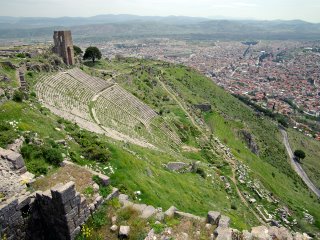
George Keenan's visit multiplied my interest in taking a group to Turkey to visit the sites of the "Seven Churches of Asia" and a variety of Pauline sites as well. George operates Rainbow Tours -- Turkey and offers several economical tours. I'm looking forward to attempting to arrange such a tour in late 2007 or the spring of 2008. As a reader of this blog, if you think you might be interested in such a trip, simply add a comment to this page including your e-mail address.
My current projects include preparing a teaching workbook on Romans for this fall here at CCV. I am also writing the text of the outline I use for teaching "First Things First," my basic doctrines class. Oh, by the way, that outline has been translated into Burmese and as soon as funds are available it will be published for distribution overseas. I also have Part II of a small church history to write. It may be simplistic, but my thesis in this book is that the changes occurring to the church over time are the result of "unintended consequences." By that, I mean that most changes were not made to subvert the church but in response to the need of the moment. There is a lesson to learn from this. It is simply that many responses to need in our present cultural situation also inevitably produce unintended consequences. Those consequences result when the response to a need ends up being calcified and hardened into "the way we've always done it." Then, too, seeing the responses to need in the past some times produces a "sheesh" response in the present. I think primarily of the current trend toward establishing satellite churches. That's exactly what the second and third century church did and it led toward the ecclesiastical structure of the Roman and Greek churches.
Enough is enough for today.
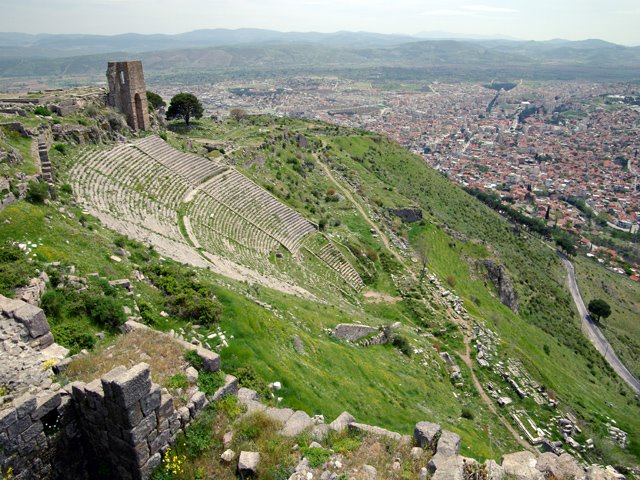
George Keenan's visit multiplied my interest in taking a group to Turkey to visit the sites of the "Seven Churches of Asia" and a variety of Pauline sites as well. George operates Rainbow Tours -- Turkey and offers several economical tours. I'm looking forward to attempting to arrange such a tour in late 2007 or the spring of 2008. As a reader of this blog, if you think you might be interested in such a trip, simply add a comment to this page including your e-mail address.
My current projects include preparing a teaching workbook on Romans for this fall here at CCV. I am also writing the text of the outline I use for teaching "First Things First," my basic doctrines class. Oh, by the way, that outline has been translated into Burmese and as soon as funds are available it will be published for distribution overseas. I also have Part II of a small church history to write. It may be simplistic, but my thesis in this book is that the changes occurring to the church over time are the result of "unintended consequences." By that, I mean that most changes were not made to subvert the church but in response to the need of the moment. There is a lesson to learn from this. It is simply that many responses to need in our present cultural situation also inevitably produce unintended consequences. Those consequences result when the response to a need ends up being calcified and hardened into "the way we've always done it." Then, too, seeing the responses to need in the past some times produces a "sheesh" response in the present. I think primarily of the current trend toward establishing satellite churches. That's exactly what the second and third century church did and it led toward the ecclesiastical structure of the Roman and Greek churches.
Enough is enough for today.
Sunday, July 09, 2006
Something to Think About
Something I’ve been wrestling with for the past couple of weeks intrigues me. According to Romans 4, Abraham’s faith was counted to him as righteousness. Does this mean Abraham’s faith resulted in his justification?
If so, then there are ramifications that need to be considered. Since justification is being declared innocent, can we say that Abraham was saved? If so, then God imputed righteousness to Abraham because of his faith and his faith saved him. This seems to match Paul’s argument in all of Romans as he says we are justified by faith.
Here’s something else to consider. Works did not save Abraham. Abraham’s faith led him to work. The same can be said of all the heroes of the faith considered in Hebrews 11. By faith, Abraham responded to God and left Ur of the Chaldees. By faith, Noah built an ark. Would I be correct to say that throughout all time, it was faith that justified men? In the Old Testament, then, those who had faith kept the Law. The Law didn’t save, but because of an explicit trust in God they obeyed him. Further, those who trusted God for their salvation observed the sacrificial system because it took blood to remit sin and each sacrifice pointed toward Jesus whose blood washes away all sin for those who trust God. At the same time, going through the motions without confidence in God was empty ceremonialism. Over and over, God warned the people not to trust in the ceremonies, the Law, or the sacrifices. According to the Word, obedience is better than sacrifice because obedience is borne of faith.
In other words, God had no Plan B for a person’s salvation. Regardless of what the Roman church or the Orthodox church taught, no work could ever possess any merit. As Jack Cottrell says so often, works are only what we ought to be doing anyway. Good deeds can’t save simply because as a creation of God, every human being belongs to him and owes him obedience. Only explicit faith (belief plus trust) can do that. The only text of this sort of faith is obedience borne of faith. Therefore, it is never faith plus works that save. It is, however, faith that leads to justification and is demonstrated in one’s obedience and upright acts (Ephesians 2:8-10).
If, and I’m just presenting a chain of thought here, faith results in justification and has done so throughout time, what is the relationship of justification and the presence of the Holy Spirit. You see, here is the rub! If the Old Testament saints were indeed justified, or saved, by their faith they were saved without the presence of the Holy Spirit. Why do I say that? It is because the Holy Spirit never indwelt anyone in the Old Testament. The Holy Spirit “came upon” certain individuals to empower them for a task, but he never took up residence. Am I correct here? If so, then there is something remarkable to consider here.
Is it possible that God could justify a person prior to baptism without the immediate bestowal of the Holy Spirit? Alexander Campbell seemed to argue that a baptism was the formal indication of the remission of sins. Is it possible that the Holy Spirit takes up residence at the time God formally remits sin (see Acts 2:38 and Acts 5:32)? But is it also possible that a person is counted righteous by his or her faith?
If a person really, and I really mean really, had explicit trust in God, wouldn’t he or she do what God asked? Why would anyone who trusted Christ question the baptismal command? Why, if they truly trusted Jesus and his Word, wouldn’t they want to be baptized as soon as possible? Why would there be any argument? After all, the faith that justifies always leads to appropriate action!!
I’d really like feedback on this.
If so, then there are ramifications that need to be considered. Since justification is being declared innocent, can we say that Abraham was saved? If so, then God imputed righteousness to Abraham because of his faith and his faith saved him. This seems to match Paul’s argument in all of Romans as he says we are justified by faith.
Here’s something else to consider. Works did not save Abraham. Abraham’s faith led him to work. The same can be said of all the heroes of the faith considered in Hebrews 11. By faith, Abraham responded to God and left Ur of the Chaldees. By faith, Noah built an ark. Would I be correct to say that throughout all time, it was faith that justified men? In the Old Testament, then, those who had faith kept the Law. The Law didn’t save, but because of an explicit trust in God they obeyed him. Further, those who trusted God for their salvation observed the sacrificial system because it took blood to remit sin and each sacrifice pointed toward Jesus whose blood washes away all sin for those who trust God. At the same time, going through the motions without confidence in God was empty ceremonialism. Over and over, God warned the people not to trust in the ceremonies, the Law, or the sacrifices. According to the Word, obedience is better than sacrifice because obedience is borne of faith.
In other words, God had no Plan B for a person’s salvation. Regardless of what the Roman church or the Orthodox church taught, no work could ever possess any merit. As Jack Cottrell says so often, works are only what we ought to be doing anyway. Good deeds can’t save simply because as a creation of God, every human being belongs to him and owes him obedience. Only explicit faith (belief plus trust) can do that. The only text of this sort of faith is obedience borne of faith. Therefore, it is never faith plus works that save. It is, however, faith that leads to justification and is demonstrated in one’s obedience and upright acts (Ephesians 2:8-10).
If, and I’m just presenting a chain of thought here, faith results in justification and has done so throughout time, what is the relationship of justification and the presence of the Holy Spirit. You see, here is the rub! If the Old Testament saints were indeed justified, or saved, by their faith they were saved without the presence of the Holy Spirit. Why do I say that? It is because the Holy Spirit never indwelt anyone in the Old Testament. The Holy Spirit “came upon” certain individuals to empower them for a task, but he never took up residence. Am I correct here? If so, then there is something remarkable to consider here.
Is it possible that God could justify a person prior to baptism without the immediate bestowal of the Holy Spirit? Alexander Campbell seemed to argue that a baptism was the formal indication of the remission of sins. Is it possible that the Holy Spirit takes up residence at the time God formally remits sin (see Acts 2:38 and Acts 5:32)? But is it also possible that a person is counted righteous by his or her faith?
If a person really, and I really mean really, had explicit trust in God, wouldn’t he or she do what God asked? Why would anyone who trusted Christ question the baptismal command? Why, if they truly trusted Jesus and his Word, wouldn’t they want to be baptized as soon as possible? Why would there be any argument? After all, the faith that justifies always leads to appropriate action!!
I’d really like feedback on this.
Wednesday, June 28, 2006
Jettison the Lord's Supper?
I’d heard it in the rumor mill, but now it’s been confirmed. At least one Christian Church scrapped the weekly Lord’s Supper.
In the first of a two-part article entitled, “How Do They Grow?,” Paul Williams noted that Christian churches are increasingly identifying with the evangelical community at large. Then, commenting on this, he added, “Some large churches and several new churches are jettisoning the Lord’s Supper from the main worship gathering of their weekend services. (The first large church of influence to do so was Central Christian Church in Las Vegas, Nevada.)
Frankly, I found this disturbing.
Watch what is said above, though. Paul said these churches are jettisoning the Lord’s Supper from the main worship gathering….” I can picture the thought process leading to that decision:
It might be argued there is precedent for this in the early church. In the second and third centuries, the church dismissed the catechumens (those preparing to become Christians) prior to observing the Eucharist (Lord’s Supper). In those days, church leaders probably applied similar reasoning. Furthermore, as testified by Justin Martyr, portions of the Lord’s Supper were taken to those believers absent from the assembly.
For all of that “high minded” reasoning, there is still a hollow ring to it. Here’s why. If weekend services are the prime time for guests, they are also the prime time for Christians. Many, perhaps most, Christians will attend a gathering on the weekend and not return during the week for a second or third assembly time. Will the churches observing the Lord’s Supper at another time make sure those unable to attend will have the opportunity to receive the elements of the Lord’s Supper? I doubt it.
I recognize the Bible gives no express command for frequency or time of observance. Nonetheless, the Christian Churches and Churches of Christ have long observed a weekly communion for a good reason: it was apparently the precedent of the early church. Acts 2:42-44 and Acts 20:7 express ample precedent for a regular, even weekly, observance of the Lord’s Supper. Testimonies from sources outside Scripture, as noted above, help us understand the early church’s practice. Whatever happened to the principle that “apostolic precedence equals divine command?”
A few years ago, the church I was serving in Ohio withdrew their support – substantial support I might add – from a missionary. They did so for two reasons. First, the elders called upon him to implement a weekly observance of the Lord’s Supper as done in Christian Churches. They saw this as an activity that identified the mission with the Restoration Movement and the Christian Churches. Second, when the missionary refused, they judged him guilty of insubordination and withdrew support. On the same basis, I wonder if they would withdraw recognition from Central Christian Church as a “real” Christian Church because of their decision to jettison the communion. I also wonder if it would make a difference if Central continued to offer communion to believers in the communion preparation room after each service.
The Catholic and Orthodox Churches continue to observe the Eucharist daily. Those groups continue to grow. It is required that a church hide what it holds to be the central truth of its confession in order to win the lost and unchurched? I don’t think so!
In the first of a two-part article entitled, “How Do They Grow?,” Paul Williams noted that Christian churches are increasingly identifying with the evangelical community at large. Then, commenting on this, he added, “Some large churches and several new churches are jettisoning the Lord’s Supper from the main worship gathering of their weekend services. (The first large church of influence to do so was Central Christian Church in Las Vegas, Nevada.)
Frankly, I found this disturbing.
Watch what is said above, though. Paul said these churches are jettisoning the Lord’s Supper from the main worship gathering….” I can picture the thought process leading to that decision:
- The Lord’s Supper is designed for Christians to remember the Lord’s sacrifice for us.
- The weekend services, especially Sunday morning, are the prime time for guests to attend.
- Many of those visiting the services will not be Christian; others will come from fellowships unfamiliar with a weekly communion service.
- Since 1) and 2) are true, the weekend services are primarily designed for “seekers.”
- Services designed for “seekers” should not involve elements that unbelievers and the unchurched will find confusing.
- Therefore, the Lord’s Supper should be jettisoned.
- The communion should be offered outside the main service or at another time. Perhaps it would be offered in another part of the building or at a service specifically designed for believers.
It might be argued there is precedent for this in the early church. In the second and third centuries, the church dismissed the catechumens (those preparing to become Christians) prior to observing the Eucharist (Lord’s Supper). In those days, church leaders probably applied similar reasoning. Furthermore, as testified by Justin Martyr, portions of the Lord’s Supper were taken to those believers absent from the assembly.
For all of that “high minded” reasoning, there is still a hollow ring to it. Here’s why. If weekend services are the prime time for guests, they are also the prime time for Christians. Many, perhaps most, Christians will attend a gathering on the weekend and not return during the week for a second or third assembly time. Will the churches observing the Lord’s Supper at another time make sure those unable to attend will have the opportunity to receive the elements of the Lord’s Supper? I doubt it.
I recognize the Bible gives no express command for frequency or time of observance. Nonetheless, the Christian Churches and Churches of Christ have long observed a weekly communion for a good reason: it was apparently the precedent of the early church. Acts 2:42-44 and Acts 20:7 express ample precedent for a regular, even weekly, observance of the Lord’s Supper. Testimonies from sources outside Scripture, as noted above, help us understand the early church’s practice. Whatever happened to the principle that “apostolic precedence equals divine command?”
A few years ago, the church I was serving in Ohio withdrew their support – substantial support I might add – from a missionary. They did so for two reasons. First, the elders called upon him to implement a weekly observance of the Lord’s Supper as done in Christian Churches. They saw this as an activity that identified the mission with the Restoration Movement and the Christian Churches. Second, when the missionary refused, they judged him guilty of insubordination and withdrew support. On the same basis, I wonder if they would withdraw recognition from Central Christian Church as a “real” Christian Church because of their decision to jettison the communion. I also wonder if it would make a difference if Central continued to offer communion to believers in the communion preparation room after each service.
The Catholic and Orthodox Churches continue to observe the Eucharist daily. Those groups continue to grow. It is required that a church hide what it holds to be the central truth of its confession in order to win the lost and unchurched? I don’t think so!
Thursday, June 22, 2006
Hebrew or Hellenist?
For years now we’ve been hearing about the dichotomy between Hebrew and Greek (Hellenistic) thought patterns. Yes, by all means, the Hebrew and Greek cultures were different. To some extent, culture does shape thought but it seems to me that when applied to understanding the Bible we must see the New Testament as a “cross-cultural” document written in Greek and thus shaped to some degree by the Hellenistic mindset.
In Josh McDowell’s and David Bellis’ recent book, The Last Christian Generation, you see this contrast brought up again. In the book, McDowell identifies many of the issues created by postmodern thinking and rightly recognizes that today’s younger generation has redefined concepts like toleration, truth, respect, acceptance, moral judgments, personal preference, personal rights, and freedom (see pp. 22-23). I wouldn’t begin to suggest that McDowell is off his rocker. In fact, he is “right on!” In my view, his critique of the postmodern generation is accurate to the letter.
When he begins the section entitled “A Blueprint to Rebuild the True Foundation of the Christian Faith,” he drops into the old saw about the difference between the Hebraic educational style and that of the Hellenists. In his assessment, he says, “Practically all of modern education, including that of most churches and Christian schools, employs a form of teaching based on a Hellenistic model of education” (p. 93). He then draws out the contrast between the two as follows:
Hellenistic
Greeks shaped much of how we think today about education and disseminating information and truth. Essentially, this Hellenistic approach is to present a student with rational and logical constructs of information that he or she is required to “learn.” To determine if the subject matter has in fact been learned, students are asked to regurgitate the information back to the teacher (p. 93).
Hebraic
The goal of the Hebrew model is not mere memorization of repeatable facts; the goal (as Moses made clear) is to live-out the truth. In this approach, truth is designed to lead to transformation. Truth in this educational approach is to be learned by practicing it in real life. … The question becomes not whether the student has the information correctly stuffed into his or her head, but rather “how has the truth transformed the student attitudinally and behaviorally” (pp. 93, 94, emphasis belongs to McDowell).
Now as far as I am concerned, this is all educational gobble-de-gook. It seems to me that the early church began using what McDowell calls the “Hellenistic” model in the second and third centuries. This was especially true in Alexandria, not known as the hotbed of Hebrew educational models. As the early church developed, it utilized catechisms (potential converts were called “catechumens”) and they “poured information into their skulls” so they would know the truth of the Gospel. As the church spread west, the educational methodology didn’t change much. Even today, the European model of education is based on independent research and “regurgitation” of certain facts to their professors. Students in primary and secondary schools must “regurgitate” what they’ve learned in tests. It’s been that way for centuries!
Why now, does McDowell, and others, make such a fuss about the difference between Hellenistic and Hebraic styles of education? After all, if you make those distinctions the church has utilized that style of education for nearly 2,000 years. Although I recognize that our kids haven’t “gone to Hell in a hand basket” of recent construction, things have indeed worsened in recent years.
The solution to the problem isn’t the erecting of an artificial wall between the Jews and the Greeks or arguing about which style of education is prevalent. The issue is whether or not, in any educational system, there is a strong distinction drawn between truth and falsehood (rightly defined). I know what McDowell is saying, and I agree with him. He says that because parents have the greatest influence upon the lives of their children, biblical truth must be caught from those Christian parents who live out their faith consistently and biblically.”
Instead, McDowell falls into the relational emphasis of the current generation. Yes, the Gen-X crowd is far more relational, but so was Europe for generations and that didn’t protect them from falling away. Let’s face it; in Europe – especially in the Eastern Bloc – the individual was less important than the community. What the relational crowd is saying is that the individual is less important than the community and it doesn’t matter whether that is the “Christian community” or any other community. It reflects a loss of individualism and stresses the submersion of the person into the community.
In my humble opinion, I don’t think you can lay the blame at the foot of some “style” of education. It is the result of numerous factors that have come together in today’s world that create difficulty for the nominal Christian. Let’s face it; we’ve lived with the lie of evolution for well over 200 years now. That lie is constantly drummed into our heads through the arts, the media, the secular classroom, and as many other places as there are places. You can’t even go to Epcot without having it drummed into your brain. Even though scientists know it is a lie, they perpetuate the myth of evolution for their own purposes.
Second, we have been living with a culture that says “self-actualization” is the epitome of success. Another term that could be used for “self-actualization” is “personal autonomy.” Again through almost every means, our culture transmits the idea that life’s goal is to be self-ruled. In is best expressed by the statement, “No one tells me what to do!” For most of our contemporary culture, that includes God!
Third, most of the problems have come about since our educational system left what McDowell called the “Hellenistic” system for that of John Dewey. Our schools, colleges, and universities no longer emphasize classical learning which places value on literature, history, languages, and the sciences, including theology, the Queen of the Sciences. Now education is measured by “outcome” and is intensely pragmatic. McDowell is right when he says we are a highly pragmatic culture and there has been a shift from “it works because it is true” to “it is true because it works.” I don’t think the blame for that rests before some Hellenistic pedagogue.
Way back in the Stone Age, when I was going to Bible College no one made the distinction between Hellenistic and Hebraic styles of learning. I was taught, however, that all truth had a “so what” component to it. Findley Edge (now that dates me) said with every teaching of biblical truth (or any other truth, for that matter), there needed to be an application! The application was how it impacted life. Does McDowell actually believe that all we’ve done is “impart to them cold theological facts about God that they can learn with their heads? (p. 94)” Well maybe some did! I’ll grant that, but to make such a generalization is inappropriate and unfair.
I teach Church History and Restoration History (history of the Christian Churches and Churches of Christ). Teaching history can be dull and boring, I admit. That’s especially true when all the instructor wants is for the student to memorize names, dates, and places and regurgitate them on call. But I don’t teach history that way! I teach those things, but I also emphasize the “so what” factor. What can we learn from the past? How will those lessons impact our lives now and in the future?
In the past, classical liberalism taught that “if you know to do right, you will do right.” Hitlerian Germany revealed the lie in that. It’s all about the “so what.” Is there knowledge to impart? Are there facts to be recognized, retained, and considered? Should those facts make a difference in our lives? The answer to all these questions is, “Absolutely!” After all, Scripture does say, “As a man thinketh in his heart, so is he!”
Let’s quit all the stuff (I want to say “crap”) about the Hellenistic and Hebraic educational styles and stand up and say, “There is truth. It is real. There is only one way to God. Let’s point to Jesus as the way, the truth and the life.” Let’s commit to overcoming Political Correctness with truth! Let’s commit to standing up for what we believe without compromise. Let’s get away from all this multiculturalism and focus on the one personality we are to all emulate.
When we do that, we will find ourselves under an awful lot of pressure. You see, the early church said Jesus was the only way. They challenged the Political Correctness of the Roman Empire which kept the peace by universal toleration of everyone except those they judged intolerant. When Christians really believe the truth, it will bring pressure. I just hope somebody can face it!
In Josh McDowell’s and David Bellis’ recent book, The Last Christian Generation, you see this contrast brought up again. In the book, McDowell identifies many of the issues created by postmodern thinking and rightly recognizes that today’s younger generation has redefined concepts like toleration, truth, respect, acceptance, moral judgments, personal preference, personal rights, and freedom (see pp. 22-23). I wouldn’t begin to suggest that McDowell is off his rocker. In fact, he is “right on!” In my view, his critique of the postmodern generation is accurate to the letter.
When he begins the section entitled “A Blueprint to Rebuild the True Foundation of the Christian Faith,” he drops into the old saw about the difference between the Hebraic educational style and that of the Hellenists. In his assessment, he says, “Practically all of modern education, including that of most churches and Christian schools, employs a form of teaching based on a Hellenistic model of education” (p. 93). He then draws out the contrast between the two as follows:
Hellenistic
Greeks shaped much of how we think today about education and disseminating information and truth. Essentially, this Hellenistic approach is to present a student with rational and logical constructs of information that he or she is required to “learn.” To determine if the subject matter has in fact been learned, students are asked to regurgitate the information back to the teacher (p. 93).
Hebraic
The goal of the Hebrew model is not mere memorization of repeatable facts; the goal (as Moses made clear) is to live-out the truth. In this approach, truth is designed to lead to transformation. Truth in this educational approach is to be learned by practicing it in real life. … The question becomes not whether the student has the information correctly stuffed into his or her head, but rather “how has the truth transformed the student attitudinally and behaviorally” (pp. 93, 94, emphasis belongs to McDowell).
Now as far as I am concerned, this is all educational gobble-de-gook. It seems to me that the early church began using what McDowell calls the “Hellenistic” model in the second and third centuries. This was especially true in Alexandria, not known as the hotbed of Hebrew educational models. As the early church developed, it utilized catechisms (potential converts were called “catechumens”) and they “poured information into their skulls” so they would know the truth of the Gospel. As the church spread west, the educational methodology didn’t change much. Even today, the European model of education is based on independent research and “regurgitation” of certain facts to their professors. Students in primary and secondary schools must “regurgitate” what they’ve learned in tests. It’s been that way for centuries!
Why now, does McDowell, and others, make such a fuss about the difference between Hellenistic and Hebraic styles of education? After all, if you make those distinctions the church has utilized that style of education for nearly 2,000 years. Although I recognize that our kids haven’t “gone to Hell in a hand basket” of recent construction, things have indeed worsened in recent years.
The solution to the problem isn’t the erecting of an artificial wall between the Jews and the Greeks or arguing about which style of education is prevalent. The issue is whether or not, in any educational system, there is a strong distinction drawn between truth and falsehood (rightly defined). I know what McDowell is saying, and I agree with him. He says that because parents have the greatest influence upon the lives of their children, biblical truth must be caught from those Christian parents who live out their faith consistently and biblically.”
Instead, McDowell falls into the relational emphasis of the current generation. Yes, the Gen-X crowd is far more relational, but so was Europe for generations and that didn’t protect them from falling away. Let’s face it; in Europe – especially in the Eastern Bloc – the individual was less important than the community. What the relational crowd is saying is that the individual is less important than the community and it doesn’t matter whether that is the “Christian community” or any other community. It reflects a loss of individualism and stresses the submersion of the person into the community.
In my humble opinion, I don’t think you can lay the blame at the foot of some “style” of education. It is the result of numerous factors that have come together in today’s world that create difficulty for the nominal Christian. Let’s face it; we’ve lived with the lie of evolution for well over 200 years now. That lie is constantly drummed into our heads through the arts, the media, the secular classroom, and as many other places as there are places. You can’t even go to Epcot without having it drummed into your brain. Even though scientists know it is a lie, they perpetuate the myth of evolution for their own purposes.
Second, we have been living with a culture that says “self-actualization” is the epitome of success. Another term that could be used for “self-actualization” is “personal autonomy.” Again through almost every means, our culture transmits the idea that life’s goal is to be self-ruled. In is best expressed by the statement, “No one tells me what to do!” For most of our contemporary culture, that includes God!
Third, most of the problems have come about since our educational system left what McDowell called the “Hellenistic” system for that of John Dewey. Our schools, colleges, and universities no longer emphasize classical learning which places value on literature, history, languages, and the sciences, including theology, the Queen of the Sciences. Now education is measured by “outcome” and is intensely pragmatic. McDowell is right when he says we are a highly pragmatic culture and there has been a shift from “it works because it is true” to “it is true because it works.” I don’t think the blame for that rests before some Hellenistic pedagogue.
Way back in the Stone Age, when I was going to Bible College no one made the distinction between Hellenistic and Hebraic styles of learning. I was taught, however, that all truth had a “so what” component to it. Findley Edge (now that dates me) said with every teaching of biblical truth (or any other truth, for that matter), there needed to be an application! The application was how it impacted life. Does McDowell actually believe that all we’ve done is “impart to them cold theological facts about God that they can learn with their heads? (p. 94)” Well maybe some did! I’ll grant that, but to make such a generalization is inappropriate and unfair.
I teach Church History and Restoration History (history of the Christian Churches and Churches of Christ). Teaching history can be dull and boring, I admit. That’s especially true when all the instructor wants is for the student to memorize names, dates, and places and regurgitate them on call. But I don’t teach history that way! I teach those things, but I also emphasize the “so what” factor. What can we learn from the past? How will those lessons impact our lives now and in the future?
In the past, classical liberalism taught that “if you know to do right, you will do right.” Hitlerian Germany revealed the lie in that. It’s all about the “so what.” Is there knowledge to impart? Are there facts to be recognized, retained, and considered? Should those facts make a difference in our lives? The answer to all these questions is, “Absolutely!” After all, Scripture does say, “As a man thinketh in his heart, so is he!”
Let’s quit all the stuff (I want to say “crap”) about the Hellenistic and Hebraic educational styles and stand up and say, “There is truth. It is real. There is only one way to God. Let’s point to Jesus as the way, the truth and the life.” Let’s commit to overcoming Political Correctness with truth! Let’s commit to standing up for what we believe without compromise. Let’s get away from all this multiculturalism and focus on the one personality we are to all emulate.
When we do that, we will find ourselves under an awful lot of pressure. You see, the early church said Jesus was the only way. They challenged the Political Correctness of the Roman Empire which kept the peace by universal toleration of everyone except those they judged intolerant. When Christians really believe the truth, it will bring pressure. I just hope somebody can face it!
Tuesday, June 20, 2006
I'm Still Here!
Last weekend concluded my first half of the doctrinal study I’ve been working on for over 10 years. All things considered, the study went very well. Several of those enrolled have already signed up for the next sequence in July. I’ve been teaching the same thing in my SAM’s Class (Senior Adults) and I raised a few eyebrows in my lessons on the Holy Spirit. I told them up front I had a few “Hines heresies” and would probably say a few things differently from anything they’d heard regardless of their background, including those from Restoration Movement churches. (I am, after all, an equal opportunity annoyer.)
I was a bit disappointed in the enrollments for the first sequence of the classes I offered. I tried an experiment by having classes Friday evening and Saturday morning for two weekends. It didn’t seem to work too well. It may be that too many want to head for the cooler hills on Friday and Saturday. It may also be unfamiliarity with several of the teachers. It may be that it was a break in what they were used to. All in all, I was disappointed but not discouraged. This fall, I’ll offer sessions for six weeks on a week night and I’ll still offer at least one “weekend intensive.”
For some of my readers who thought I’d have to compromise my convictions when I came here, I want you to know I have not done so. I do recognize, however, that those attending Christ's Church of the Valley come from all kinds of backgrounds. I teach with the same spirit I used in Canton, Ohio, and elsewhere. I always present doctrinal teaching derived from reason or inference, whether coming from deduction or induction, with love. I do the best I can to evidence a humble spirit while presenting firmly what I believe is biblical truth. I guess I’m just too much of a Restorationist, for I continue to hold on to Thomas Campbell’s Proposition 7 from his famous “Declaration and Address.” (If you don’t know what that says, look it up. If you have trouble understanding it, search for Knofel Staton’s paraphrase.)
It is good practice to remember “we are not the only Christians, we are Christians only.” I think A. Campbell was right when he said there were only two things required to become a Christian: 1) The belief of one essential fact and 2) the submission to one essential act. (You know what those are!) It is wise to understand there are all sorts of stupid ideas out there about a lot of things in Scripture. I’m sure you and I even possess a few of them! Item number two always seems to be a “bug bear.” Yet Carl Ketcherside used to say, “Even if others don’t know what baptism is all about, God does!” Carl is right, and our relationship with God doesn’t depend on our full understanding but our compliance to Christ’s commands. We all have different perspectives, but if we are teachable we can listen. I don’t worry too much about those who have different ideas, but I hope they are teachable and will test what I say against Scripture. After all no one answers to me; everyone answers to God. He alone is the only qualified judge.
Do I agree with everything I hear? No! But I didn’t agree with everything at Canton either. Furthermore, I didn’t agree with everything at what was then First Church of Christ in Boise (a far more conservative congregation than most) either. I do agree that Jesus is the Christ. I do agree that he put us here to make disciples, to baptize them into Christ, and to teach them to observe all things.
Nothing in my belief system has changed! There is one thing that has changed, however. I’m working harder than I have for a long time.
I was a bit disappointed in the enrollments for the first sequence of the classes I offered. I tried an experiment by having classes Friday evening and Saturday morning for two weekends. It didn’t seem to work too well. It may be that too many want to head for the cooler hills on Friday and Saturday. It may also be unfamiliarity with several of the teachers. It may be that it was a break in what they were used to. All in all, I was disappointed but not discouraged. This fall, I’ll offer sessions for six weeks on a week night and I’ll still offer at least one “weekend intensive.”
For some of my readers who thought I’d have to compromise my convictions when I came here, I want you to know I have not done so. I do recognize, however, that those attending Christ's Church of the Valley come from all kinds of backgrounds. I teach with the same spirit I used in Canton, Ohio, and elsewhere. I always present doctrinal teaching derived from reason or inference, whether coming from deduction or induction, with love. I do the best I can to evidence a humble spirit while presenting firmly what I believe is biblical truth. I guess I’m just too much of a Restorationist, for I continue to hold on to Thomas Campbell’s Proposition 7 from his famous “Declaration and Address.” (If you don’t know what that says, look it up. If you have trouble understanding it, search for Knofel Staton’s paraphrase.)
It is good practice to remember “we are not the only Christians, we are Christians only.” I think A. Campbell was right when he said there were only two things required to become a Christian: 1) The belief of one essential fact and 2) the submission to one essential act. (You know what those are!) It is wise to understand there are all sorts of stupid ideas out there about a lot of things in Scripture. I’m sure you and I even possess a few of them! Item number two always seems to be a “bug bear.” Yet Carl Ketcherside used to say, “Even if others don’t know what baptism is all about, God does!” Carl is right, and our relationship with God doesn’t depend on our full understanding but our compliance to Christ’s commands. We all have different perspectives, but if we are teachable we can listen. I don’t worry too much about those who have different ideas, but I hope they are teachable and will test what I say against Scripture. After all no one answers to me; everyone answers to God. He alone is the only qualified judge.
Do I agree with everything I hear? No! But I didn’t agree with everything at Canton either. Furthermore, I didn’t agree with everything at what was then First Church of Christ in Boise (a far more conservative congregation than most) either. I do agree that Jesus is the Christ. I do agree that he put us here to make disciples, to baptize them into Christ, and to teach them to observe all things.
Nothing in my belief system has changed! There is one thing that has changed, however. I’m working harder than I have for a long time.
Thursday, June 01, 2006
My experience at the movie
I came away from The DaVinci Code, the movie, thinking to myself: This movie is more deceptive than the book.
Some of you who braved it, saw the movie and probably came away thinking it was much to-do about nothing. Perhaps you got caught up in the story and didn’t keep your “filters” on to evaluate what you saw and heard. I suppose some of you found the whole 2 hours and 29 minutes as somewhat boring.
I didn’t!
Just like the book, for me the story line was captivating. For conspiracy theorists, the movie (and the book) was the epitome of conspiracy theories. A corrupt and power hungry Catholic Church determined to keep a world-changing secret to the extent that murder and mayhem was common place. A beautiful “descendant” of Jesus and a researcher (Tom Hank’s character) who did his best to keep his head while assenting to the reality of the historian’s dilemma.
That’s where the rub came in for me! The movie toned down some of the blatant anti-Christian and anti-Catholic rhetoric, but the sentiments were there nonetheless. Robert Langdon’s responses to Teabing’s assertions were weak and half-hearted attempts to tone down the language, but at best he sounded like a member of the Jesus Seminar. His weak protests as Teabing unraveled his story hardly satisfied the viewer with questions. In fact, they were so weak they made Teabing’s arguments sound all the more reasonable. That’s deceptive. Langdon, a symbologist and ersatz historian, would have had knowledge that raised stronger objections than presented. Why even liberal scholar Bart Ehrman did better than that!
I don’t want to overplay this, but I did hear people talking about the movie as I came out of the theater. Their questions and the discussions I overheard indicated they had some real questions about the history of the church. Without someone to help them, it will be easy for them to come to the wrong conclusions. After all, Brown, who was involved in the movie’s production, still maintains that much of what he wrote is based on fact. In fact, there are lines in the movie that acknowledges and anticipates the attacks on the movie and book by biblical and historical scholars. That makes it even more deceptive as well.
Let’s consider that for a moment. It is a fact there were finds at Nag Hammadi, but they weren’t exactly what Brown said they were. Opus Dei does exist, but it isn’t what he said it was. The Templars were a monastic order formed during the Crusades, but they didn’t do what he said they did. The Gnostic gospels do exist, but they don’t portray the Jesus he says they do. There really was a Priory of Sion, but it wasn’t formed when he said it was and there is no evidence to the contrary. The French police do exist, but given their track record, I doubt they are as aggressive as those portrayed in the book and the movie. There really is a glass pyramid at the Louvre, but the number of glass panes is off in Brown’s book. The paintings he describes exist, too, but there are some important size differences as well as other qualities that he twists for his own purposes. Fact! Well, yes, if a half-truth (no, an eighth-truth) is fact then I suppose you could say that. But a half-truth told with the intent to deceive is still a lie!
Some of you who braved it, saw the movie and probably came away thinking it was much to-do about nothing. Perhaps you got caught up in the story and didn’t keep your “filters” on to evaluate what you saw and heard. I suppose some of you found the whole 2 hours and 29 minutes as somewhat boring.
I didn’t!
Just like the book, for me the story line was captivating. For conspiracy theorists, the movie (and the book) was the epitome of conspiracy theories. A corrupt and power hungry Catholic Church determined to keep a world-changing secret to the extent that murder and mayhem was common place. A beautiful “descendant” of Jesus and a researcher (Tom Hank’s character) who did his best to keep his head while assenting to the reality of the historian’s dilemma.
That’s where the rub came in for me! The movie toned down some of the blatant anti-Christian and anti-Catholic rhetoric, but the sentiments were there nonetheless. Robert Langdon’s responses to Teabing’s assertions were weak and half-hearted attempts to tone down the language, but at best he sounded like a member of the Jesus Seminar. His weak protests as Teabing unraveled his story hardly satisfied the viewer with questions. In fact, they were so weak they made Teabing’s arguments sound all the more reasonable. That’s deceptive. Langdon, a symbologist and ersatz historian, would have had knowledge that raised stronger objections than presented. Why even liberal scholar Bart Ehrman did better than that!
I don’t want to overplay this, but I did hear people talking about the movie as I came out of the theater. Their questions and the discussions I overheard indicated they had some real questions about the history of the church. Without someone to help them, it will be easy for them to come to the wrong conclusions. After all, Brown, who was involved in the movie’s production, still maintains that much of what he wrote is based on fact. In fact, there are lines in the movie that acknowledges and anticipates the attacks on the movie and book by biblical and historical scholars. That makes it even more deceptive as well.
Let’s consider that for a moment. It is a fact there were finds at Nag Hammadi, but they weren’t exactly what Brown said they were. Opus Dei does exist, but it isn’t what he said it was. The Templars were a monastic order formed during the Crusades, but they didn’t do what he said they did. The Gnostic gospels do exist, but they don’t portray the Jesus he says they do. There really was a Priory of Sion, but it wasn’t formed when he said it was and there is no evidence to the contrary. The French police do exist, but given their track record, I doubt they are as aggressive as those portrayed in the book and the movie. There really is a glass pyramid at the Louvre, but the number of glass panes is off in Brown’s book. The paintings he describes exist, too, but there are some important size differences as well as other qualities that he twists for his own purposes. Fact! Well, yes, if a half-truth (no, an eighth-truth) is fact then I suppose you could say that. But a half-truth told with the intent to deceive is still a lie!
Tuesday, May 23, 2006
One More Thought on The DaVinci Code

Now that the movie is out and seemingly doing well at the box office, permit me one more observation about the book and the movie. It is interesting, though; that the critics are panning it and my friends who have seen the movie say it is tiresome.
Dr. Jim Garlow visited us (Christ's Church of the Valley) for a presentation on Dan Brown’s controversial work. Garlow holds a Ph.D. in Church History and he knows his stuff. The problem I saw during his presentation is that those hearing him without a Church History background received a lot of information in a short time. It was like trying to take a drink from a fire hydrant.
Garlow pointed out that the book left many believers confused and some abandoned the faith because of it. He contended the movie could do greater damage. While I haven’t yet seen the movie, I think he’s right. In spite of the fact that some of the overtly anti-Christian rhetoric is toned down, enough subtle information comes across that can do a lot of damage.
Why do I think it can do so much damage? It is because most Christians are as historically illiterate as they are biblically illiterate. That’s not true just of the man and woman in the pew! Many church leaders hardly know more than the average Christian. All too many endured Church History in college and seminary thinking it was all about the theology of a bunch of dead guys. The man or woman in the pew endured courses in Western Civilization. They all too often slept through the boring lectures on the uniting of the Roman Empire under Constantine. As a result, they are at the mercy of every Tom, Dick, and Harry who turns Constantine into history’s “bad guy.” Writers like Dan Brown do pseudo-history and blatantly lie about Constantine and the Council of Nicaea and no one is the wiser. Brown can lie about the beginnings of Opus Dei because no one cares when it was actually founded. He can lie about the Templars because only a few know who or what they were. Adolf Hitler said, “If you tell a lie big enough and often enough it will be believed.”
I appreciated the fact that Garlow took the position that the book and the movie present a myriad of opportunities for Christians to “give a reason for the hope that lies within them” (1 Peter 3:15). But … you have to understand the reason for the hope! Somewhere somehow someone has to absorb some biblical and historical content in order to be able to share the truth when confronted with lies.
Oh, by the way! I’m convinced that most of our troubles in this country worsened when we stopped teaching history in the public schools. Contemporary “Social Studies” programs instill a mediocre – if that – understanding of who settled his continent, why it was settled, and how our country came to be. At North Canton (OH) Hoover High School which is one of the top schools in northeast Ohio, only advanced placement students took more than a rudimentary introduction to history. According to the school superintendent, “It just doesn’t seem to fit a program designed to help a young person make a living.”
Philosopher George Santayana said, “Those who refuse to learn the lessons of history are doomed to repeat them.” We – the church and the nation – are reaping what we’ve sown!
Tuesday, May 16, 2006
Boycotts and Hunger Strikes Confront Movie
It’s here! But not without trouble blowing in the wind.
According to Fox News, protests regarding “The DaVinci Code” are springing up around the world. Catholics and Protestants alike are promising boycotts, hunger strikes, and public protests. I’ve not heard much about such goings on here in the good ol’ USA, but they will probably happen.
I have mixed feelings about such protests. The truth is: “Bad news is better than no news at all!” I’m afraid these actions may serve only to promote the movie and the book inspiring it. I plan to go see it as soon as some of the furor dies down, not because I like the idea portrayed in the movie but because I want to know how it compares with the book. The book was a real “page-turner,” and the movie is sure to be a blockbuster.
There is something bugging me, however. Every time I go to Barnes & Noble I see more books on subjects like “The DaVinci Code.” Authors taking their cues from Dan Brown are writing all sorts of trash about Jesus, the Gnostic writings, a supposed Gospel of Judas, and more. By the way, I guess if Judas wrote a gospel that means he didn’t commit suicide as described in Scripture. If that’s the case, then the Bible is wrong and we can’t know what to believe. As I stopped by the bookstore just today, I saw books about the myth of Christ, secrets of the Templars, Mary Magdalene, and a lot more. As I looked over all those books, I thought, It seems like Satan is waging an all out attack on the credibility of Scripture right now!
I think there is one positive about this entire if we “play our cards right.” Over the last several decades, American Christians drifted into a contentless emotional faith based on feelings. Truth is defined as “what is true for me.” That kind of “truth” is usually based on feelings as opposed to what can be verified by objective evidence.
Dan Brown’s book and the movie are driving us back to the objective evidence for Jesus and the church. It is high time, too! Brown’s work is raising all kinds of questions that can’t be answered by “how you feel” at any given moment. Just because following Jesus gives you a “spiritual high” doesn’t tell you whether or not he was human or divine or both. It can’t tell you if the resurrection occurred or whether Jesus was a real person who lived in space and time. Only evidence can do that. Maybe Jesus can give you a “spiritual high,” but so can mushrooms! There is a huge difference between a drug-induced high, a meaningless spiritual high, and the reality that Jesus is God demonstrated by his resurrection from the dead.
Maybe … just maybe … the potential confusion this book and movie could create will cause the church to realize the importance of “sound doctrine” once again. While we don’t want to minimize the importance of relating Scripture to every day life, there really are core truths that Christians must understand, accept, and pass on to others.
Let’s wait and see the outcome of all of this. The movie may flop (not likely, but it’s possible). Perhaps the initial stir it all creates will quickly disappear as believers share the truth with the many questioners coming out of the theaters.
Just something to think about!
According to Fox News, protests regarding “The DaVinci Code” are springing up around the world. Catholics and Protestants alike are promising boycotts, hunger strikes, and public protests. I’ve not heard much about such goings on here in the good ol’ USA, but they will probably happen.
I have mixed feelings about such protests. The truth is: “Bad news is better than no news at all!” I’m afraid these actions may serve only to promote the movie and the book inspiring it. I plan to go see it as soon as some of the furor dies down, not because I like the idea portrayed in the movie but because I want to know how it compares with the book. The book was a real “page-turner,” and the movie is sure to be a blockbuster.
There is something bugging me, however. Every time I go to Barnes & Noble I see more books on subjects like “The DaVinci Code.” Authors taking their cues from Dan Brown are writing all sorts of trash about Jesus, the Gnostic writings, a supposed Gospel of Judas, and more. By the way, I guess if Judas wrote a gospel that means he didn’t commit suicide as described in Scripture. If that’s the case, then the Bible is wrong and we can’t know what to believe. As I stopped by the bookstore just today, I saw books about the myth of Christ, secrets of the Templars, Mary Magdalene, and a lot more. As I looked over all those books, I thought, It seems like Satan is waging an all out attack on the credibility of Scripture right now!
I think there is one positive about this entire if we “play our cards right.” Over the last several decades, American Christians drifted into a contentless emotional faith based on feelings. Truth is defined as “what is true for me.” That kind of “truth” is usually based on feelings as opposed to what can be verified by objective evidence.
Dan Brown’s book and the movie are driving us back to the objective evidence for Jesus and the church. It is high time, too! Brown’s work is raising all kinds of questions that can’t be answered by “how you feel” at any given moment. Just because following Jesus gives you a “spiritual high” doesn’t tell you whether or not he was human or divine or both. It can’t tell you if the resurrection occurred or whether Jesus was a real person who lived in space and time. Only evidence can do that. Maybe Jesus can give you a “spiritual high,” but so can mushrooms! There is a huge difference between a drug-induced high, a meaningless spiritual high, and the reality that Jesus is God demonstrated by his resurrection from the dead.
Maybe … just maybe … the potential confusion this book and movie could create will cause the church to realize the importance of “sound doctrine” once again. While we don’t want to minimize the importance of relating Scripture to every day life, there really are core truths that Christians must understand, accept, and pass on to others.
Let’s wait and see the outcome of all of this. The movie may flop (not likely, but it’s possible). Perhaps the initial stir it all creates will quickly disappear as believers share the truth with the many questioners coming out of the theaters.
Just something to think about!
Monday, May 01, 2006
Get Ready for "The DaVinci Code"!

Nineteen days from now Ron Howard’s movie, The DaVinci Code, hits the theaters. With Tom Hanks in the lead role, the movie is bound to be a blockbuster. Frankly, I’m looking forward to it! The book was “a real page turner.” At the same time, I know it is going to raise a storm of criticism on one hand and a lot of questions on the other.
God providentially let me prepare for the release of the movie. Knowing it was coming, I began looking for resources a long time ago. One of the best books was Dr. Jim Garlow’s, Cracking the DaVinci Code. I bought and read that book with interest. Garlow is a historian and was able to shed a lot of light on Dan Brown’s mistaken understanding of the Nag Hammadi Library and Gnostic writings in general. Garlow, a Wesleyan Methodist, presents a defense for traditional Christianity from the perspective of a conservative Christian.
Written from the perspective of one who accepts much of the liberal critical scholarship, Dr. Bart Ehrman’s work, Truth and Fiction in the DaVinci Code, scathingly repudiates Brown’s book. I purchased Ehrman’s book at one of the local Barnes & Noble stores along with his Lost Christianities. When I picked up Ehrman’s book on the DaVinci Code, I fully expected him to support Brown. Imagine my surprise when I found him rejecting Brown and his book. Ehrman is a historian who understands early Christian history. I guess I shouldn’t be so surprised.
It seems, then, that both those who accept some of the current critical theories and those who reject them out of hand reject Brown’s assertions.
Now let’s admit one thing. In spite of Brown’s comment on the “fly leaf” that a list of things is fact, what he says about them is fiction. There is in the Catholic Church an organization known as Opus Dei. It is not, however, what Brown says it is. There was an ancient militaristic monastic order known as the Templars, but they did not do what Brown says they did. There were amazing discoveries of Gnostic writings at Nag Hammadi in the late 1940s, but they do not say what Brown says they tell us about Jesus. There were documents discovered in caves above the Dead Sea in 1947 (not the 1950s as Brown says), but they tell us absolutely nothing about Jesus. So, while many of the places, organizations, and so on are real places; Brown treats them fictionally. His book is a book of murder, mystery, intrigue, and conspiracy; it is not historical fiction!
Dr. Garlow encourages people to see the movie. He also encourages you to take unsaved friends with you. Then, after the movie, spend time discussing it. That means you have to be understand where and how Brown twists history to suit his fictional purpose. Here at Christ’s Church of the Valley, we intend to screen a response to the movie on Wednesday, May 24. By then the buzz will be underway and people can view the video presentation then remain for Q&A. I will moderate and answer as many questions as I can.
For those of you wondering about resources, let me direct you to a couple of possibilities. Lee Strobel’s website at http://www.leestrobel.com/ has a lot of good stuff. D. James Kennedy will air a documentary May 13, 14 on “The Coral Ridge Hour.” More information at http://www.coralridge.org/. Check out the Worldnet Daily website at http://www.worldnetdaily.com/ for a link to a documentary done on what was once PAX TV. You can also go to www.ionline.tv/specials. Josh McDowell has a book out and a handy downloadable personal study at http://www.truefoundations.com/. McDowell’s stuff has a 3-part sermon series and notes, multi-media presentation, and more for approximately $50. Jeff Bigelow has a downloadable sermon you can get at www.preachingstandard.com/private/resourceprint.asp?id=209.
Well, I hope this all helps.
Thursday, April 27, 2006
LET'S TALK IMMIGRATION
It seems like everyone is talking about immigration these days. A couple of weeks ago, there was a 100,000 person march here in Phoenix in support of assimilating illegal immigrants into our culture and citizenship. I have just a few thoughts about the topic.
First, Immigrants built the United States. Most of those who made the greatest contribution to our nation and our culture came into the United States legally. I suppose the Native Americans (who really aren’t native either) living on this continent in the 14th and 15th Centuries could claim those first Europeans were “illegal aliens.” Other than that, it was Europeans who settled the United States both before and after it became a nation. It was those early settlers, particularly in the southern colonies, who purchased Africans to work the indigo and do unpleasant work as “permanently indentured servants.” By 1800 importing slaves was illegal but smugglers got some into the country nonetheless. Throughout the rest of the 19th Century and the early 20th Century, waves of immigrants came from Ireland, Germany, Scandinavia, Italy, and southeastern Europe. Many of those immigrants came into the United States with the idea they would make their fortune and return to their homeland. It took at least two generations before their children began abandoning their European languages and culture for that of their new homeland.
My point in this is two-fold. First, those who came into the country legally then and now make tremendous contributions to our culture, economy, and way of life. Second, we need to give immigrants time to assimilate.
Second, illegal immigration can eventually destroy an empire. In it’s hey day, the Roman Empire ruled from North Africa to the Danube River and from the Atlantic to the borders of the Persian Empire. Roman legions protected the borders, roads, sea lanes, and made travel and trade possible. By the third century AD, however, the Empire was unable to recruit sufficient citizen soldiers to maintain a level of force needed to sustain its mission. As a result, barbarians from the north began crossing into the Empire from the north. Visigoths, Ostrogoths, and Vandals began making their homes on land given up by Romans who could no longer make it productive and profitable. Many of these “invaders” had better morals, better work habits, and a better worldview. By the way, most of them were Christians albeit a variety of Christendom not looked upon with favor. They were Arian Christians identified with a man named Arius who was judged as a heretic.
In time, some of these “illegal aliens” made their way into the Roman army. Adding to their numbers were other barbarian mercenaries hired to complement Roman citizen-soldiers so they could fulfill their mission.
Invasion of barbarian armies began in the late fourth century. Visigoths invaded in the east and were eventually put down by the Roman army under the leadership of a barbarian mercenary general named Stillicho. At the same time, however, Burgundians invaded the western portion of the empire. Stilicho’s forces were spread too thin to be able to handle both invasions. Honorius, the Roman emperor, accused Stillicho of duplicity and treason. Stilicho was eventually assassinated in a plot that served only to turn barbarian mercenaries against the empire. In AD 410, Alaric invaded the empire and sacked Rome. Many historians date the fall of Rome to the date of its sack in AD 410.
Here’s the thing! Most of those who slipped across the border into Rome and took up farming or other honest occupations weren’t the problem. They wanted a “slice of the Roman pie.” Life was better in the Roman Empire than it was in the cold northern climates from which they came. At the same time, in spite of their desire to partake of the empire’s benefits, they were a potentially volatile population. Their volatility reared itself in the face of “perceived Roman rejection and persecution” resulting in the empire’s destruction.
Now let’s bring this up to the present.
The founding fathers of this nation believed the new nation would be “a city on a hill.” Within a few years of the founding of this nation, many believed it was the “manifest destiny” of the United States, not to rule the world, but to spread its ideal of a nation of the people, by the people, and for the people” worldwide or a least on this continent. They believed millions would be drawn to this land because of its freedoms and its opportunities. Yet they believed there needed to be an orderly way for others to become part of the American Dream. The government adopted its immigration laws and policies to bring that to reality.
That doesn’t mean there weren’t problems. Unless first generation immigrants had sufficient money to move inland and take up farming, they ended up in the cities where they were looked down upon as poor, ignorant, and even more damning, Catholic. Workers looked down upon these poor people because they willingly worked for lower wages. Protestants looked upon them with suspicion because they were Catholic. Occasional outbreaks of violence accompanied the distrust and suspicion creating problems. In time and with a good measure of determination and hard work, these immigrants settled in, became successful, and were considered good Americans. In some cases, the adversity of war (The War of 1812, the Mexican-American War, the Civil War, and so on) earned them a place. They learned English, became productive, and contributed much.
In recent years, we’ve gained much from immigrants from India, Vietnam, other Asian countries, and from Cuba and Hispanics who came here legally.
Today, however, we live in different times. We live in an era of cultural and moral relativism. One culture or way of life is seen as no better or worse than any other. To some extent, I suppose there is some validity to that. When I go to Asia, I don’t present myself as coming from a superior culture. I’ve learned to see some genuine values in the Christian culture of Myanmar (that culture practiced by Christians). But I can tell you this: Most of those who live in Myanmar yearn for the freedoms we enjoy, the rights we take for granted, and the standard of living that increases their life span, their well-being, and their opportunities for sharing the Gospel. If I were to go there permanently, I would expect to learn the Burmese language and that of the people I plan to serve. In this country, however, we have taken this idea to idiotic extremes. We no longer expect those coming into the country to learn English, adapt to American customs, and assimilate into the culture.
Let me make one thing abundantly clear. I do not care if you speak Vietnamese, Spanish, German, or Latvian at home. I do care that you are unwilling to learn the language of your new country so you can become a part of its multi-ethnic population. I do not care if you want to celebrate Cinco de Mayo, Mardigras, Bastille Day, or May Day with your friends. I do care if you expect everyone else to do so. I don’t even care if you want to eat Lute Fisk, Blood Pudding, or Curried Mutton. I do care if you think everyone should do it. I don’t care if you are black, red, white, or brown as long as you are an American (I’d really like to say Christian here, but I believe in freedom of religion no matter how stupid other religions are).
As long as this nation permits illegal immigration to occur on our porous borders and we continue this silly multiculturalism, we are following in the same footsteps of the Roman Empire. Instead of those who would take over our farms, trash hauling, and landscaping businesses, though, we may wake up one morning to the news there is a mushroom cloud over one of our major cities. For you see, in our day there is a possibility that someone with a suitcase nuke could infiltrate our borders along with that Mexican worker who only wants a better way of life for his family. Not only that, but citizens will continue to experienced increased taxation as a nation of illegals continues to drain welfare and public assistance budgets.
Well, that’s my take on it. Immigrants enriched this nation, but let’s continue to “do it right.” Let’s protect our borders and, at the same time, welcome those who choose to make their home with us. Let’s learn from them and welcome the good things they bring us. Like the engineers and doctors from India, the mathematics whizzes from Asia, or even the baseball players from the Dominican Republic, let’s help them realize what it means to be an American.
Oh, by the way! Christians, let’s do all we can to help them discover the lordship of Christ while we’re at it. Do you realize that one of the greatest foreign mission fields in the world is right here at home?
First, Immigrants built the United States. Most of those who made the greatest contribution to our nation and our culture came into the United States legally. I suppose the Native Americans (who really aren’t native either) living on this continent in the 14th and 15th Centuries could claim those first Europeans were “illegal aliens.” Other than that, it was Europeans who settled the United States both before and after it became a nation. It was those early settlers, particularly in the southern colonies, who purchased Africans to work the indigo and do unpleasant work as “permanently indentured servants.” By 1800 importing slaves was illegal but smugglers got some into the country nonetheless. Throughout the rest of the 19th Century and the early 20th Century, waves of immigrants came from Ireland, Germany, Scandinavia, Italy, and southeastern Europe. Many of those immigrants came into the United States with the idea they would make their fortune and return to their homeland. It took at least two generations before their children began abandoning their European languages and culture for that of their new homeland.
My point in this is two-fold. First, those who came into the country legally then and now make tremendous contributions to our culture, economy, and way of life. Second, we need to give immigrants time to assimilate.
Second, illegal immigration can eventually destroy an empire. In it’s hey day, the Roman Empire ruled from North Africa to the Danube River and from the Atlantic to the borders of the Persian Empire. Roman legions protected the borders, roads, sea lanes, and made travel and trade possible. By the third century AD, however, the Empire was unable to recruit sufficient citizen soldiers to maintain a level of force needed to sustain its mission. As a result, barbarians from the north began crossing into the Empire from the north. Visigoths, Ostrogoths, and Vandals began making their homes on land given up by Romans who could no longer make it productive and profitable. Many of these “invaders” had better morals, better work habits, and a better worldview. By the way, most of them were Christians albeit a variety of Christendom not looked upon with favor. They were Arian Christians identified with a man named Arius who was judged as a heretic.
In time, some of these “illegal aliens” made their way into the Roman army. Adding to their numbers were other barbarian mercenaries hired to complement Roman citizen-soldiers so they could fulfill their mission.
Invasion of barbarian armies began in the late fourth century. Visigoths invaded in the east and were eventually put down by the Roman army under the leadership of a barbarian mercenary general named Stillicho. At the same time, however, Burgundians invaded the western portion of the empire. Stilicho’s forces were spread too thin to be able to handle both invasions. Honorius, the Roman emperor, accused Stillicho of duplicity and treason. Stilicho was eventually assassinated in a plot that served only to turn barbarian mercenaries against the empire. In AD 410, Alaric invaded the empire and sacked Rome. Many historians date the fall of Rome to the date of its sack in AD 410.
Here’s the thing! Most of those who slipped across the border into Rome and took up farming or other honest occupations weren’t the problem. They wanted a “slice of the Roman pie.” Life was better in the Roman Empire than it was in the cold northern climates from which they came. At the same time, in spite of their desire to partake of the empire’s benefits, they were a potentially volatile population. Their volatility reared itself in the face of “perceived Roman rejection and persecution” resulting in the empire’s destruction.
Now let’s bring this up to the present.
The founding fathers of this nation believed the new nation would be “a city on a hill.” Within a few years of the founding of this nation, many believed it was the “manifest destiny” of the United States, not to rule the world, but to spread its ideal of a nation of the people, by the people, and for the people” worldwide or a least on this continent. They believed millions would be drawn to this land because of its freedoms and its opportunities. Yet they believed there needed to be an orderly way for others to become part of the American Dream. The government adopted its immigration laws and policies to bring that to reality.
That doesn’t mean there weren’t problems. Unless first generation immigrants had sufficient money to move inland and take up farming, they ended up in the cities where they were looked down upon as poor, ignorant, and even more damning, Catholic. Workers looked down upon these poor people because they willingly worked for lower wages. Protestants looked upon them with suspicion because they were Catholic. Occasional outbreaks of violence accompanied the distrust and suspicion creating problems. In time and with a good measure of determination and hard work, these immigrants settled in, became successful, and were considered good Americans. In some cases, the adversity of war (The War of 1812, the Mexican-American War, the Civil War, and so on) earned them a place. They learned English, became productive, and contributed much.
In recent years, we’ve gained much from immigrants from India, Vietnam, other Asian countries, and from Cuba and Hispanics who came here legally.
Today, however, we live in different times. We live in an era of cultural and moral relativism. One culture or way of life is seen as no better or worse than any other. To some extent, I suppose there is some validity to that. When I go to Asia, I don’t present myself as coming from a superior culture. I’ve learned to see some genuine values in the Christian culture of Myanmar (that culture practiced by Christians). But I can tell you this: Most of those who live in Myanmar yearn for the freedoms we enjoy, the rights we take for granted, and the standard of living that increases their life span, their well-being, and their opportunities for sharing the Gospel. If I were to go there permanently, I would expect to learn the Burmese language and that of the people I plan to serve. In this country, however, we have taken this idea to idiotic extremes. We no longer expect those coming into the country to learn English, adapt to American customs, and assimilate into the culture.
Let me make one thing abundantly clear. I do not care if you speak Vietnamese, Spanish, German, or Latvian at home. I do care that you are unwilling to learn the language of your new country so you can become a part of its multi-ethnic population. I do not care if you want to celebrate Cinco de Mayo, Mardigras, Bastille Day, or May Day with your friends. I do care if you expect everyone else to do so. I don’t even care if you want to eat Lute Fisk, Blood Pudding, or Curried Mutton. I do care if you think everyone should do it. I don’t care if you are black, red, white, or brown as long as you are an American (I’d really like to say Christian here, but I believe in freedom of religion no matter how stupid other religions are).
As long as this nation permits illegal immigration to occur on our porous borders and we continue this silly multiculturalism, we are following in the same footsteps of the Roman Empire. Instead of those who would take over our farms, trash hauling, and landscaping businesses, though, we may wake up one morning to the news there is a mushroom cloud over one of our major cities. For you see, in our day there is a possibility that someone with a suitcase nuke could infiltrate our borders along with that Mexican worker who only wants a better way of life for his family. Not only that, but citizens will continue to experienced increased taxation as a nation of illegals continues to drain welfare and public assistance budgets.
Well, that’s my take on it. Immigrants enriched this nation, but let’s continue to “do it right.” Let’s protect our borders and, at the same time, welcome those who choose to make their home with us. Let’s learn from them and welcome the good things they bring us. Like the engineers and doctors from India, the mathematics whizzes from Asia, or even the baseball players from the Dominican Republic, let’s help them realize what it means to be an American.
Oh, by the way! Christians, let’s do all we can to help them discover the lordship of Christ while we’re at it. Do you realize that one of the greatest foreign mission fields in the world is right here at home?
Thursday, April 13, 2006
BIBLICAL WORSHIP
Patternists, those who seek a New Testament pattern for the church, have for years attempted to see a biblical pattern for worship. Alexander Campbell dealt with this in the Millennial Harbinger, disavowing Acts 2:42 as the blueprint the early church followed for worship. Last summer, Lee Mason, the current editor of The Restoration Herald hinted at the same idea. I know I might be wrong, but after considerable thought I’ve decided there is no biblical model for corporate worship in the New Testament.
Let’s think about that for a while!
In the Old Testament worship occurred at a place. Worship always involved an altar and sacrifice. In fact, I think I can safely say there was no worship without sacrifice. Once Moses led Israel from Egypt, God revealed to Moses an entire system of worship focused on the altar at the Tabernacle. The “Tent of Worship,” as it was sometimes called, was a moveable temporary structure. All Israel looked forward to the time when the focus of worship would be in a permanent location. Once David established Jerusalem as his capital, he yearned to erect a permanent Temple. Because he was a “man of war,” God permitted him to assemble the building materials but he was not allowed to build the Temple. That remained for Solomon to do. Once Solomon completed and dedicated the Temple, all worship took place there. In fact, no worship took place outside the Temple confines.
At this juncture, I have to say that there was no single “day of worship” set aside in Israel. Since worship involved sacrifice, Israelites could worship at the Temple every day. The priests sacrificed animals for a variety of reasons every day. They slaughtered so many animals that there were specially constructed drains to permit most of the blood to flow away from the Temple area. You see, worship involved sacrifice!
The Sabbath day was not set aside as a day of worship. It was, instead, a day of rest. The fourth commandment, as recorded in Exodus 20, reads as follows: “Remember the Sabbath day, to keep it holy. Six days you shall labor and do all your work, but the seventh day is the Sabbath of the LORD your God. In it you shall do no work: you, nor your son, nor your daughter, nor your manservant, nor your maidservant, nor your cattle, nor your stranger who is within your gates. For in six days the LORD made the heavens and the earth, the sea, and all that is in them, and rested the seventh day. Therefore, the LORD blessed the Sabbath day and hallowed it” (Exodus 20:10, 11). Deuteronomy 5 repeats this commandment focusing on the Sabbath as a day of rest. The Jews also observed other Sabbaths, or holidays when normal work did not occur. These days might take place during festivals or other special days, but they weren’t days of worship. Neither were the numerous festivals and feasts days of worship. Those were days of commemoration and remembrance designed to keep specific events in their minds and hearts. Worship happened during those special days as the priests offered sacrifices, but the festivals themselves weren’t truly worship. The Day of Atonement was an exception to the rule. On the Day of Atonement, the priests offered a special sacrifice for the people’s sins and the High Priest took blood from that animals and sprinkled it on the mercy seat. That day was a day of worship because the whole purpose was the atoning sacrifice offered to God to expiate the people’s sins.
In 586, Nebuchadnezzar created a crisis for the Jews when his armies destroyed the Temple, stopped the sacrifices, and deported many of the people. Until Ezra and Nehemiah returned to Jerusalem with Cyrus’ blessing, there was no worship. Without sacrifice there is no worship!
It is during those years of the Babylonian Captivity that we see the rise of the Synagogue. Wherever ten Jewish men wished to gather together they could establish a Synagogue. Gatherings at Synagogue were not worship assemblies. The Synagogue was a means of preserving the Jewish heritage and traditions. Because the Sabbath was a day of rest, the stoppage of work for a day served as a natural time for gathering together to hear the reading of the Book, to discuss the meaning of the passage read, and in general to recall their tremendous history as God’s special people. I’m sure they yearned for the day when they could return to the holy city and rebuild the Temple and restore the sacrifices so they could worship.
It was also during the time of the captivity that the “teachers of the law” and the Hasidim, who many think eventually became the Pharisees, began to emphasize obedience to the law. After all, Samuel once said, “To obey is better than to sacrifice” (1 Samuel 15:22). Since sacrifices could not be offered, these teachers taught that the people’s obedience was preferable to sacrifice. It was a moot point, however, because there was no place to sacrifice!
When Cyrus, king of Persia, permitted the people of Israel to return to Jerusalem, they rebuilt the Temple. Sadly, however, it had little of the glory and beauty possessed by Solomon’s Temple. It was, however, the place of sacrifice. Those who returned to the land could once again worship. Jews everywhere desired to travel to Jerusalem at least once in their lifetime so they could worship. The Synagogue continued its role as the place for teaching the Torah and where those scattered Jews could retain their traditions and heritage. Worship did not occur at Synagogue, worship required sacrifice.
Later Herod the Great began a tremendous reconstruction and beautification project on the Temple. If memory serves me correctly, that project had been underway some 40 years when Jesus began his ministry. It continued for even more years until it was completed in AD 66.
When Jesus lived and walked among us, he said something interesting to an adulterous woman at a well in Samaria. During that conversation, the woman, in an attempt to divert attention from herself, asked, “Our ancestors worshiped on this mountain. But you Jews say that people must worship in Jerusalem” (John 4:20). Jesus replied, “Believe me. A time is coming when you Samaritans won’t be worshiping the Father on this mountain or in Jerusalem” (John 4:21). It is a good thing the disciples were gone on a quest for dinner because Jesus tells this woman that a time is coming when worship could take place anywhere because true worship is accomplished “in spirit and in truth” (John 4:24). To suggest that worship could take place somewhere other than in Jerusalem would have “raised their eyebrows” for sure! You see, worship required sacrifice.
For the Jews, the worst possible scenario unfolded in AD 70. The Roman armies under Titus assembled outside Jerusalem’s walls. This took place during the last days of an ill-advised rebellion against the world’s superpower of that day. After a six month siege, Titus breached the walls, slaughtered the inhabitants, and destroyed the Temple. They fulfilled Jesus words to the letter, “You see all these buildings (the temple buildings)? I can guarantee this truth: Not one of these stones will be left on top of another. Each one will be torn down” (Matthew 24:2). From that day to this, only the wailing wall, a portion of the temple court’s west wall, remains. It is a place of prayer; it is not a place of worship.
Why have I gone into all this? It is simple. In my view, what occurs on Sunday is not necessarily worship. There is no New Testament pattern for the gatherings that take place on that day.
You see, worship requires a Temple and sacrifice. Is there such a thing in these New Testament times? Absolutely!
You, individually and collectively, are God’s Temple. Your body is the temple of the Holy Spirit (1 Corinthians 6:19). Living stones comprise God’s contemporary Temple. These stones are laid upon the foundation of the Apostles and the Prophets with Jesus, the stone the builders rejected, who is the chief cornerstone. God’s Temple is not a place, it is a people. Those people exist in Myanmar, Thailand, Russia, China, the United States, and in almost every other nation in the world.
Since worship requires sacrifice, is there sacrifice. Yes, but it is not the blood of bulls and goats. Paul describes a different kind of sacrifice: “Brothers and sisters, because of God’s compassion toward us, I encourage you to offer your bodies as living sacrifices, dedicated to God and pleasing to him. This kind of worship is appropriate for you” (Romans 12:1).
Your acceptable sacrifice is the giving up of your life to become like Christ. It is a sacrifice you offer at work on Monday, with your family Tuesday evening, in your small group whenever it meets, in the weekend assembly, or giving up something you desire in the flesh for the growth of your spirit. Sacrifice is giving up what you cannot keep to gain what you cannot lose. Sacrifice is putting Christ and His Word first in your life. Sacrifice is taking self off the throne of your life and making Christ Lord! Sacrifice is giving up your preferences so others can come to know Jesus as King. Such sacrifice is rooted in a love for God and an intimate relationship with Jesus. Sacrifice is setting aside your will to obey God, for obedience is an exhibition of sacrifice.
Why do we gather together in assemblies we call church? Is it to worship. Worship can occur in such gatherings, but it isn’t neatly tied up in a package called “praise music.” You see, you can worship anywhere at any time. You don’t need music! You don’t need prayer. You don’t need an offering. The purpose of coming together is “to encourage each other even more as we see the day of the Lord coming” (Hebrews 10:25). In a sense, these assemblies fulfill the same role as the Synagogue -- they help us maintain our heritage, remember our traditions, teach sound doctrine, and provide biblical guidance for facing life situations. In our culture, these assemblies also become tools to reach others with the good news that Jesus changes lives. Whether these assemblies are thousands strong or six individuals gathered in someone’s front room is irrelevant. The real issue is, do they encourage, build up, and inspire personal sacrifice for Christ and the church?
We tend to get wrapped up and bent out of shape over how various congregations do things. Culture guides most of the things done in these gatherings. When I grew up in the Midwest, few considered dancing appropriate in church buildings let alone the assemblies. In Thailand, however, my experiences there lead to the conclusion that dance is an expression of love and praise for God. While we sing some of the old standard hymns in Myanmar, since our mission teams encouraged them to write music for their own culture we’re seeing more and more unfamiliar tunes in the gatherings there. Every assembly, however, memorializes the Lord’s death, teaches biblical truth, and challenges the believers to daily sacrifice for Jesus. Is that worship? I suppose you can call it that, but technically it is the believers’ daily sacrifice that constitutes worship. Does it really matter whether we offer an invitation, sing Gaither praise music, or make sure only men serve the Lord’s Supper? Does it matter if we gather on a night or day other than Sunday? We gather on Sunday because of the example of the early church, but they gathered together far more often than that.
Keep in mind that genuine worship requires sacrifice! How are you worshiping these days?
Let’s think about that for a while!
In the Old Testament worship occurred at a place. Worship always involved an altar and sacrifice. In fact, I think I can safely say there was no worship without sacrifice. Once Moses led Israel from Egypt, God revealed to Moses an entire system of worship focused on the altar at the Tabernacle. The “Tent of Worship,” as it was sometimes called, was a moveable temporary structure. All Israel looked forward to the time when the focus of worship would be in a permanent location. Once David established Jerusalem as his capital, he yearned to erect a permanent Temple. Because he was a “man of war,” God permitted him to assemble the building materials but he was not allowed to build the Temple. That remained for Solomon to do. Once Solomon completed and dedicated the Temple, all worship took place there. In fact, no worship took place outside the Temple confines.
At this juncture, I have to say that there was no single “day of worship” set aside in Israel. Since worship involved sacrifice, Israelites could worship at the Temple every day. The priests sacrificed animals for a variety of reasons every day. They slaughtered so many animals that there were specially constructed drains to permit most of the blood to flow away from the Temple area. You see, worship involved sacrifice!
The Sabbath day was not set aside as a day of worship. It was, instead, a day of rest. The fourth commandment, as recorded in Exodus 20, reads as follows: “Remember the Sabbath day, to keep it holy. Six days you shall labor and do all your work, but the seventh day is the Sabbath of the LORD your God. In it you shall do no work: you, nor your son, nor your daughter, nor your manservant, nor your maidservant, nor your cattle, nor your stranger who is within your gates. For in six days the LORD made the heavens and the earth, the sea, and all that is in them, and rested the seventh day. Therefore, the LORD blessed the Sabbath day and hallowed it” (Exodus 20:10, 11). Deuteronomy 5 repeats this commandment focusing on the Sabbath as a day of rest. The Jews also observed other Sabbaths, or holidays when normal work did not occur. These days might take place during festivals or other special days, but they weren’t days of worship. Neither were the numerous festivals and feasts days of worship. Those were days of commemoration and remembrance designed to keep specific events in their minds and hearts. Worship happened during those special days as the priests offered sacrifices, but the festivals themselves weren’t truly worship. The Day of Atonement was an exception to the rule. On the Day of Atonement, the priests offered a special sacrifice for the people’s sins and the High Priest took blood from that animals and sprinkled it on the mercy seat. That day was a day of worship because the whole purpose was the atoning sacrifice offered to God to expiate the people’s sins.
In 586, Nebuchadnezzar created a crisis for the Jews when his armies destroyed the Temple, stopped the sacrifices, and deported many of the people. Until Ezra and Nehemiah returned to Jerusalem with Cyrus’ blessing, there was no worship. Without sacrifice there is no worship!
It is during those years of the Babylonian Captivity that we see the rise of the Synagogue. Wherever ten Jewish men wished to gather together they could establish a Synagogue. Gatherings at Synagogue were not worship assemblies. The Synagogue was a means of preserving the Jewish heritage and traditions. Because the Sabbath was a day of rest, the stoppage of work for a day served as a natural time for gathering together to hear the reading of the Book, to discuss the meaning of the passage read, and in general to recall their tremendous history as God’s special people. I’m sure they yearned for the day when they could return to the holy city and rebuild the Temple and restore the sacrifices so they could worship.
It was also during the time of the captivity that the “teachers of the law” and the Hasidim, who many think eventually became the Pharisees, began to emphasize obedience to the law. After all, Samuel once said, “To obey is better than to sacrifice” (1 Samuel 15:22). Since sacrifices could not be offered, these teachers taught that the people’s obedience was preferable to sacrifice. It was a moot point, however, because there was no place to sacrifice!
When Cyrus, king of Persia, permitted the people of Israel to return to Jerusalem, they rebuilt the Temple. Sadly, however, it had little of the glory and beauty possessed by Solomon’s Temple. It was, however, the place of sacrifice. Those who returned to the land could once again worship. Jews everywhere desired to travel to Jerusalem at least once in their lifetime so they could worship. The Synagogue continued its role as the place for teaching the Torah and where those scattered Jews could retain their traditions and heritage. Worship did not occur at Synagogue, worship required sacrifice.
Later Herod the Great began a tremendous reconstruction and beautification project on the Temple. If memory serves me correctly, that project had been underway some 40 years when Jesus began his ministry. It continued for even more years until it was completed in AD 66.
When Jesus lived and walked among us, he said something interesting to an adulterous woman at a well in Samaria. During that conversation, the woman, in an attempt to divert attention from herself, asked, “Our ancestors worshiped on this mountain. But you Jews say that people must worship in Jerusalem” (John 4:20). Jesus replied, “Believe me. A time is coming when you Samaritans won’t be worshiping the Father on this mountain or in Jerusalem” (John 4:21). It is a good thing the disciples were gone on a quest for dinner because Jesus tells this woman that a time is coming when worship could take place anywhere because true worship is accomplished “in spirit and in truth” (John 4:24). To suggest that worship could take place somewhere other than in Jerusalem would have “raised their eyebrows” for sure! You see, worship required sacrifice.
For the Jews, the worst possible scenario unfolded in AD 70. The Roman armies under Titus assembled outside Jerusalem’s walls. This took place during the last days of an ill-advised rebellion against the world’s superpower of that day. After a six month siege, Titus breached the walls, slaughtered the inhabitants, and destroyed the Temple. They fulfilled Jesus words to the letter, “You see all these buildings (the temple buildings)? I can guarantee this truth: Not one of these stones will be left on top of another. Each one will be torn down” (Matthew 24:2). From that day to this, only the wailing wall, a portion of the temple court’s west wall, remains. It is a place of prayer; it is not a place of worship.
Why have I gone into all this? It is simple. In my view, what occurs on Sunday is not necessarily worship. There is no New Testament pattern for the gatherings that take place on that day.
You see, worship requires a Temple and sacrifice. Is there such a thing in these New Testament times? Absolutely!
You, individually and collectively, are God’s Temple. Your body is the temple of the Holy Spirit (1 Corinthians 6:19). Living stones comprise God’s contemporary Temple. These stones are laid upon the foundation of the Apostles and the Prophets with Jesus, the stone the builders rejected, who is the chief cornerstone. God’s Temple is not a place, it is a people. Those people exist in Myanmar, Thailand, Russia, China, the United States, and in almost every other nation in the world.
Since worship requires sacrifice, is there sacrifice. Yes, but it is not the blood of bulls and goats. Paul describes a different kind of sacrifice: “Brothers and sisters, because of God’s compassion toward us, I encourage you to offer your bodies as living sacrifices, dedicated to God and pleasing to him. This kind of worship is appropriate for you” (Romans 12:1).
Your acceptable sacrifice is the giving up of your life to become like Christ. It is a sacrifice you offer at work on Monday, with your family Tuesday evening, in your small group whenever it meets, in the weekend assembly, or giving up something you desire in the flesh for the growth of your spirit. Sacrifice is giving up what you cannot keep to gain what you cannot lose. Sacrifice is putting Christ and His Word first in your life. Sacrifice is taking self off the throne of your life and making Christ Lord! Sacrifice is giving up your preferences so others can come to know Jesus as King. Such sacrifice is rooted in a love for God and an intimate relationship with Jesus. Sacrifice is setting aside your will to obey God, for obedience is an exhibition of sacrifice.
Why do we gather together in assemblies we call church? Is it to worship. Worship can occur in such gatherings, but it isn’t neatly tied up in a package called “praise music.” You see, you can worship anywhere at any time. You don’t need music! You don’t need prayer. You don’t need an offering. The purpose of coming together is “to encourage each other even more as we see the day of the Lord coming” (Hebrews 10:25). In a sense, these assemblies fulfill the same role as the Synagogue -- they help us maintain our heritage, remember our traditions, teach sound doctrine, and provide biblical guidance for facing life situations. In our culture, these assemblies also become tools to reach others with the good news that Jesus changes lives. Whether these assemblies are thousands strong or six individuals gathered in someone’s front room is irrelevant. The real issue is, do they encourage, build up, and inspire personal sacrifice for Christ and the church?
We tend to get wrapped up and bent out of shape over how various congregations do things. Culture guides most of the things done in these gatherings. When I grew up in the Midwest, few considered dancing appropriate in church buildings let alone the assemblies. In Thailand, however, my experiences there lead to the conclusion that dance is an expression of love and praise for God. While we sing some of the old standard hymns in Myanmar, since our mission teams encouraged them to write music for their own culture we’re seeing more and more unfamiliar tunes in the gatherings there. Every assembly, however, memorializes the Lord’s death, teaches biblical truth, and challenges the believers to daily sacrifice for Jesus. Is that worship? I suppose you can call it that, but technically it is the believers’ daily sacrifice that constitutes worship. Does it really matter whether we offer an invitation, sing Gaither praise music, or make sure only men serve the Lord’s Supper? Does it matter if we gather on a night or day other than Sunday? We gather on Sunday because of the example of the early church, but they gathered together far more often than that.
Keep in mind that genuine worship requires sacrifice! How are you worshiping these days?
Subscribe to:
Comments (Atom)