Wednesday, September 15, 2004


Someone better start thinking!

It will happen sooner or later!

I see it often! Some church looking for a preacher puts a notice in the Christian Standard or on ChristianChurchToday.com stating the qualifications for their position. These qualifications include the ability to preach, teach, lead, evangelize, and in some instances work well with a multiple staff. Then the notice says the candidate will be between the ages of 35-50 with at least "x" years of experience.

It is amazing that no one has, to this point, challenged such blatant age discrimination. Churches continue to demonstrate such discrimination when the business world abandoned it long ago. The business world abandoned it because it is against the law to discriminate in hiring practices based on age, gender, or race. Numerous lawsuits settled that issue and guilty business paid the price for their discrimination.

I am not so naive to believe that those in the business world still avoid hiring some individuals based on prejudice. At the same time, however, they cannot blantantly ask the age of an individual. Birth dates no longer appear on application forms or resumes. Businesses have become far more discreet in their practices whether it be for hiring or "retiring" individuals in their firm.

Churches have a right to hire and fire whom they will, but the laws of the land apply to them as well unless there are biblical or spiritual principles involved. I can understand why church leaders choose not to hire women for pulpit ministries since Scripture, at least in many minds, does not permit a woman to teach (publicaly, as in sermonizing). A church is on shaky legal ground, in my view, if race or age are stated factors in hiring and firing.

Age may play a factor in effectiveness in ministry. Such effectiveness may be legitimate, but a church that assumes someone is ineffective because of age is being unfair to themselves and to the individual. Older and experienced ministers have much to offer growing congregations. Their wisdom may save a church from expensive mistakes leading to financial hardships and internal strife. Many older ministers know and understand church growth principles far better than their younger counterparts and could be highly effective in an environment of support and respect.

The tendency to avoid calling older, more experienced, ministers to pulpit ministries grows more out of chronological snobbery than reality. It is assumed that they cannot communicate with the younger generations. The fact is, the prejudice arises from younger generations who believe those who are older have nothing to offer. A growing lack of respect for parents and for authority in general is demonstrated in the church toward their more mature counterparts.

Sooner or later some well-qualified preacher is going to weary of blatant age discrimination and a church or churches will find themselves before the bar defending their hiring practices in a lawsuit. When that happens, I hope the contemporary church's chronological snobbery will be revealed for what it is and result in its demise. Where are those in today's church who understand the biblical instruction to "respect those who are older"? Just asking!

Thursday, September 09, 2004


We must not permit peripheral issues to divide us.

Walking a Tightrope

We in the Restoration Movement walk a tightrope between legalism and license, between evangelicalism and sacramentalism, and between being a denomination and Christians only. Walking a tight rope is not the same as "walking the fence" or, to use a long gone political epithet, being a "mugwump."

Those of us on the tightrope try to maintain a balance. While holding onto Restoration values, we try very hard to accept people and question theology. It is difficult to express brotherhood without seemingly rejecting those with whome we differ on one hand or being seen as compromisers on the other. No matter what you do, someone will question your motives and your commitment to Christ. It is much easier to choose up sides. What is often misunderstood is the fact that one can, on the basis of one's own study, take a position and hold it with conviction without condemning or rejecting those who differ.

I have a strong conviction about what the Bible teaches regarding Christ's return. I teach it without compunction or regret, but I still believe those who accept other views love the Lord and are brothers or sisters in Christ. I admit to being impatient on occasion with those who hold a differing position as if it were the only way to understand the biblical data. I also admit to getting a bit feisty when brotherhood publications present a one-sided view without balancing it with alternatives. The Christian Standard, for example, published "Why I Am a Premillennial" by my brother David Reagan. The author of a companion article in the Standard spoke of how eschatological views affect foreign policy and how the USA is seen by others. The author wrote from an amillennial perspective, that was clear, but it was not a "Why I Am an Amillennial" presentation. Not long ago, David Reagan spoke at the NACC but there was no presentation that presented the amillennial, postmillennial, or the various dispensational views.

I also hold strong convictions about the doctrine of inerrancy. Yet when I express the belief that Scripture is inerrant, the hackles go up. When the controversy was smoldering in the late 1970s and the 1980s, a mention of inerrancy or a challenge of those who rejected it was tantamount to excommunication. Of course there were those on both sides of the issue ready to excommunicate the other. Dr. Jack Cottrell, who in my mind, presented strong convincing arguments for the doctrine was villified as one who wanted to divide the brotherhood and a (shudder) Calvinist. I strongly disagree with my brothers and sisters who take a different view of inerrancy. In my opinion, I think their view of Scripture and biblical authority is weak and anemic. but they are still fellow Christians and I can fellowship with them, work with them, and, with good nature, argue with them.

I hold strong convictions about the purpose and nature of baptism. I believe the Bible teaches "baptism for (the purpose) of the remission of sins and the gift of the Holy Spirit" (Acts 2:38). I won't teach or preach anything else. I'm a bit perplexed by brothers who have weakened, at least in print and sermon, weakened that view. I'm not always sure how much their view has actually changed and how much is marketing spin. On this issue, even Alexander Campbell found it difficult to "walk the tightrope." I don't think anyone would argue that Campbell did not believe baptism was immersion in water for the remission of sins. At the same time, he would not make it absolutely essential for salvation. You see, Campbell taught that it was his opinion that God would save those of genuine faith who obeyed to the extent of their understanding. In illustration and written word, he taught that God held people accountable for what they knew and comprehended. On the one hand, it is dangerous to water down the purpose of immersion for marketing. On the other hand, it is equally dangerous to be condemning and unkind to those who don't understand the biblical teaching. It is a tightrope one must walk, however, to be faithful to the Word of God and Restoration values.

I could go on, but suffice it to say that loving the brotherhood is often misunderstood for condoning error or becoming a narrow exclusivist. I don't want to be identified as either. You see, I am not the only Christian but I do want to be a Christian only.

Tuesday, September 07, 2004

Shoving it under the rug!

Perhaps it's because the Restoration Movement talks about Christian unity! Maybe there are other subtle forces at work. I'm never sure, but when issues of concern arise one of two things often happens. Voices become shrill and antagonistic or the whole issue gets shoved under the rug and ignored. Let me explain.

One illustration of what I'm talking about occurred about 20 years ago when Harold Lindsell wrote Battle for the Bible. Not long after the book appeared, Christianity Today published articles relating to biblical inerrancy and the evangelical world was caught up in turmoil. Dr. Jack Cottrell wrote a little book on biblical authority and inerrancy not long after. The Christian Standard published excerpts from it. These articles resulted in loud and often unkind diatribes as well as equally shrill defenses. I know because I wrote some of those defenses. Letters accused Dr. Cottrell of introducing a "new doctrine," seeking to "divide the brotherhood," and being an "evangelical." During a "debate" at the North American Christian Convention, Myron Taylor called Cottrell a Calvinist and suggested you could expect nothing less from a man who was educated at Princeton Theological Seminary. The interchanges lasted a couple of years then more or less petered out.

At the same time, concerns arose over the denial of inerrancy at one of our three seminaries. Dr. Joe Carson Smith and a group of concerned individuals documented the school's denial of inerrancy and sent that documentation to each congregation in the Restoration Movement. I still have my copy of that information in my files. What the documentation reveals is a consistent effort on the part of the seminary to sweep the whole issue under the rug. The school's reaction ranged from, "How could you possibly suspect us of being unfaithful to the Word?" to "The Restoration Movement doesn't get involved in such theological hairsplitting." Interestly enough, however, the school's president used language more consistent with evangelicalism than did those who questioned the school's stand. The tactics employed were designed to leave the impression that the charges were essentially the result of a "war of words" between sister schools in the Restoration Movement. With that said, the issue of inerrancy was successfully swept under the rug and the whole thing died out.

In the days, months, and years since, any discussion of inerrancy evokes memories of the shrill accusations and the issue is once again ignored leaving only suspicion and distrust in the wake.

A glance at our history reveals this same thing has happened numerous times. In the 1800s when Liberalism began creeping into movement schools individuals began recognizing that professors at the historic College of the Bible in Kentucky were advocating the Liberal line. When challenged, the school utilized the same tactics employed more recently and the issue of Liberalism was ignored. College of the Bible eventually was lost to Liberalism.

In the 1920s and 30s, the issue of Open Membership arose as a challenge to the brotherhood. Concerned voices became shrill and tension increased. Brotherhood officials, in an attempt to sweep the issue under the rug, assured the more conservative voices that Open Membership would not be practiced but congregations and missions continued to receive the "pious unimmersed" into membership. The lack of concerted and honest discussion led to separation and the fracture became more or less permanent when the Disciples formalized themselves into a denomination in the 1960s.

About 20 years ago, David Filbeck and John Greenlee were warning us that the twin issues of evangelical creep and questions of the purpose of baptism would arise. The Christian Standard printed their articles and shrill voices responded. Eventually, however, the whole issue was swept under the rug. We are reaping the result of that today. Congregations are now identifying themselves with the evangelical mainstream and baptism has been separated from remission of sins and is now seen in many places as "the first step of obedience after salvation."

The way we resolve tensions in the Restoration Movement is hampered by our lack of connections. We have no structure in which to discuss and resolve issues that create tension. Our educational institutions tend to increase the tensions because they take one position or another and positions become hardened and motives questioned. The Christian Standard was once an "open forum" for discussion on troubling issues but it has become a "leadership journal" with few, if any, articles discussing biblical doctrine or truth. There is no place to discuss such issues and even if we had one, our congregations remain fully independent with the ability to choose whatever path they wish.

Because of this, some have argued that the North American Christian Convention should become a delegate convention where we can discuss such issues. Most of us, I hope, realize that in this case the cure would be worse than the disease. While our independent nature creates numerous problems for us, it has also resulted in tremendous freedom and multiple blessings. Perhaps the best that we can do is to recognize the flaws in the "system" and work with it. In doing so, we must recognize that we will "lose" some to theologically and biblically indefensible systems and practices. In other words, let's love one another and live with it.

It has ever been so in the Restoration Movement. We lost Dr. John Thomas who later formed the Christadelphians. We lost Sidney Rigdon who was crucial to the formation of the Church of Jesus Christ of Latter Day Saints. We lost the College of the Bible and other schools to Liberalism. We lost churches in Washington and California, among others, to evangelicalism. We are going to win some and lose some. I hate it, but I'm not sure there is any way out of the predicament. We can, however, learn to love one another and when the opportunity arises, discuss issues openly and honestly with civility. Perhaps avoiding the shrill accusations will result in more open discussion. Then again, maybe not!

Thursday, September 02, 2004


Generations are different!

Generations are at it again!

Generational issues always seem to cause tension. Paul alludes to such tension when he told Timothy and Titus to respect those who are older. The Apostle also told Timothy not to permit others to “disrespect” his youth. I don’t remember exactly who it was, but I seem to remember it was Clement of Alexandria who counseled the young lions of that day to respect those who were older.

It is no different today. There is growing tension between generational groups in the church. The “music wars” are symptomatic of the tension but it can be observed in many other ways as well. In fact, the “music wars” serve as the tip of the ice berg.

One example of the tension in addition to the “music wars” is the chronological snobbery of the younger generations. In some growing congregations it is a given that no one over 40 will speak from the pulpit/platform. Since the church’s “target group” is the younger generation (Boomers mostly), it is assumed that an older fellow won’t communicate in a way that meets the needs of the younger generation. In addition, the preaching style the older preacher brings might well to too linear for the postmodern crowd. A young man in the Canton Church summed it up beautifully. In a conversation with me about the possibility of an older teacher leading a young marrieds’ class, he said, “What could possibly have to say to us?”

A similar example is the hiring practices of most intergenerational churches these days. Go to
www.christianchurchtoday.com and take a gander at the posted ads for ministerial candidates. Most churches seek a younger man and make no bones about it. Frankly, I’m waiting for the day when a candidate is rejected because of age and a church is taken to court for age discrimination. I know of churches that fired their preacher because he was “too old” or “they felt they needed a younger man in the pulpit.” George Barna, in his book Turn Around Churches, advises plateaued or stagnant churches to hire a younger minister. With few exceptions, one being Ben Merold, older fellows are rejected out of hand.

Congregations make assumptions based on age. It is assumed that an older preacher is of “the old school” or “thinks old.” That is not necessarily the case! There are older men who understand the generational differences, the postmodern scene, and the importance of creating relationships. At the same time, there are younger men who think old and who are unable to adjust themselves to the culture around them.

Many in the “older” generation have tremendous experience with and understand church growth principles. Furthermore, they possess a mature understanding of church interaction, relationships, and administrative details. Having seen the mistakes of the past they have much to offer those who need to avoid the mistakes of the future. There is wisdom in gray hair that is rare in younger leadership. Congregations deny themselves access to fantastic resources when they assume older leaders have nothing to offer.

On the other side of the coin, older leaders need input from younger generations. Mature leaders need to develop relationships with younger men and disciple them. If those of us with gray hair do not take the time “wade through” the loud music, clothing styles, and sometimes goofy attitude, you can expect them to reject you. Every generation needs to go “cross cultural” and recognize what the other can contribute. God makes us different on purpose. Whether we talk about individuals, a nation, or a generation, God has his reasons for the uniqueness of each. We must learn not to compromise our convictions, dumb down our beliefs, but accept each other in spite of our differences. It is only when we can learn from each other, respect each other, and work together that we will really make a difference.


Saturday, August 28, 2004


How stuff happens!

Some people have the idea that Roman Catholicism and Greek Orthodoxy were thought up by a bunch of guys in a back room smoking stogies and drinking booze. Well, er, some of those guys did take a sip or two, I'm sure. After all, Paul told Timothy to take a little wine for his stomach's sake.

At any rate, we want to see changes in the church -- particularly changes we don't like -- resulting from the evil desire to distort the church. Now I will be the first to admit that Satan is a deceiver, and he often deceives good people and the results are catastrophic. But I submit you that those who instigate change, even hurtful change, don't always do so because of bad motives.

Let's think about this for a moment!

It is clear from the New Testament text that elders led the early church, particularly after it moved out into the wider Roman Empire. Paul told Timothy and Titus to "ordain elders in every city." Church historians almost universally acknowledge two classes of leadership in the early church:
    1. Apostles, Prophets, and Teachers.
    2. Bishops, Elders, and Deacons

Consider the second group, the leaders established in the local congregation. I believe Scripture tells us the Bishop and the Elder were synonymous and each congregation had more than one. By the end of the first century, there was a move to elevate one of the Elders to the position of Bishop. We see this in a few of the letters Ignatius of Antioch wrote while on his way to Rome to die a martyr's death. The elevation of one individual puzzles historians because Ignatius was from the Antioch church and undoubtedly knew Paul. Why would he counsel elevating one individual and use the term Bishop to designate him? Ignatius made the suggestion to meet a need. Persecution and the proliferation of false doctrine made strong and decisive leadership essential in a congregation. When persecution comes, a church can't afford to take the time to defer to a college of Elders to determine what to do. Leadership invested in one individual is far more efficient. I don't think Ignatius realized his suggestion would eventually result in the full-blown hierarchy of the Catholic and Orthodox Churches! The suggestion carried with it "unforeseen consequences" he could not identify from his vantage point in history.

Another example can be seen in the development of Creeds. The earliest church required a simple statement of belief, "I believe that Jesus is the Son of God." Before long, the statement enlarged to profess belief not only in Jesus, but in God the Father and the Holy Spirit as well. Through the centuries successive Creeds expanded on the original simple statement of belief. Why? In each case, an expanded Creed was written to deal with rising false doctrine challenging the church. Credalism led to sectarianism and division down the road. What was intended as unifying became devisive. Division was an "unintended consequence" of creedalism, but the Creeds were written with the best of intentions.

I bring all of this to your attention to remind you that some of the changes I've bewailed in this blog do not always arise from the hearts of evil men determined to subvert the brotherhood. Some of those receiving the harshest criticism as "abandoning the faith" or "denying the validity of the Restoration Movement" seriously and conscientiously believe they are doing the right thing. They accept the Great Commission and honestly desire to win men and women to Jesus Christ. While I sometimes disagree with the results -- maybe because of my interest in history I can see the potential for "unintended consequences" -- and their thinking, I do not want to disparage their motives or intent. I can't see into the heart, but I personally know many of those I criticize and know them to be men who love God, love the brotherhood, and love me.

I constantly try to remind myself of what I have just written. I call upon all my brothers in Christ to constantly submit their teaching, methodology, and motivation to the Word of God. I have to ask myself if I want to glorify self or Jesus. Perhaps we all need to ask ourselves that and try to be a little more honest than we've been.

Friday, August 27, 2004

Transformed or Conformed?

Visit Saddleback, North Coast, Willow Creek, Maryland Community, any Vineyard Community Church, or any other of hundreds of evangelical churches and you discover remarkable conformity in worship style and methodology. When my wife and I attended a Presbyterian Church in Franklin, KY, without our daughter and son-in-law, I was struck by the fact that the service was virtually identical to any of a thousand other contemporary services. Oh, I forgot, we did recite the Apostle's Creed in that service. You'll find the same kind of conformity in nearly all Christian Churches and Churches of Christ; especially in our mega-churches.

Pick up brochures from each of these congregations and you will find conformity in programming, statements of belief, organizational structure and the like. In the statements of belief you'll find basic statements about the Trinity, Deity of Christ, Virgin Birth, and the Holy Spirit. Statements on how one is saved are also similar with an emphasis on faith, repentance, confession (sometimes put as a "sinner's prayer"), and baptism. With few exceptions, statements about baptism are nebulous at best. In non Restoration Movement congregations, statements about baptism are phrased as "a symbolic act which testifies to what the Holy Spirit has done." These congregations, as does Saddleback for example, link baptism to membership in a local congregation. Statements found in Restoration Movement Congregations are also nebulous presenting baptism was a "symbol of what the Holy Spirit accomplishes." In some cases, baptism is seen as part of "a process" that brings one into fellowship with Christ and the church. I didn't surf the net as widely as I'd have liked, but I found only one mega-church with a statement that is even close to the biblical view that baptism is the "time" when one is regenerated and brought from Satan's kingdom into "the kingdom of His Dear Son."

Two things need to be said here. (1) Many evangelicals understand perfectly the mode and purpose of baptism. George Beasley Murray's magnificant study on baptism made that quite clear. More and more evangelicals, when doing theological writing -- which is rare! -- sound increasingly like Restorationists. To say from the pulpit or to put in writing in their congregation what they have come to believe would put them in a difficult position with their members who are so steeped in evangelical traditions they would react negatively. (2) Restorationists, once convinced that baptism was the point where one met the blood of Christ, now flee from that position. Alexander Campbell stubbornly held to the believe that regeneration occurred at baptism although he did not believe in baptismal regeneration (see essays in the 1833 Millennial Harbinger). Campbell believed the Holy Spirit (God) did the regenerating, not the water.

To make baptism seem more palatable, our preachers have put baptism into the midst of a process. In the new view, no part of the process should be distinguished from the other. An analogy is made to marriage. When is a person married? At the engagement? At the conclusion of the vows? When the proclamation is made? When the documents are signed? When the relationship is consummated on the marriage bed? We don't know, we're told, but we all rejoice. This is a kind of "spiritual agnosticism." It suggests we don't know when salvation occurs -- at the moment of faith, the moment of reprentance, the moment of confess, the moment of baptism? Since we can't know, we should just rejoice that we have a new member in the family of God.

This is just drivel! It is an attempt to soften the historic Restoration Position in such a way as to make it palatable. It is conformity to the evangelical world so we don't seem "out of it" or "strange" or "wierd" or a "cult." If I remember correctly, Peter did say, "Repent and be immersed every one of you in the name of Jesus Christ for the remission of sins and you shall receive the gift of the Holy Spirit" (Acts 2:38). Paul did write, "You were buried with Christ by baptism and raised with him to walk in newness of life" (see Romans 6). Readers should also study carefully Colossians 2:12-13. It doesn't take a genius to see that baptism is the point when all the blessings promised through faith in Christ are bestowed upon a penetent believer. Again, the water doesn't wash you clean, the Holy Spirit does, but regeneration occurs at the time of one's baptism into Christ.

Too many just want to be accepted. They want to be like everyone else. There is a kind of religious conformity at work that results in a dulling of sensibilities. The result is a dumbing down that denies the authority of Scripture, the real work of the Holy Spirit, and the importance of discipleship. Paul said we should be transformed by the renewing of our mind -- our mind -- not just the conformity to current religious trends that excite the emotions and senses of those around us.

Thursday, August 26, 2004


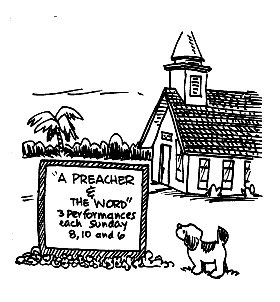
The caption says it all!

The search for respect

I get those e-mails suggesting I'm old because I can remember Blackjack gum, Studebaker cars, and nickle ice cream cones. Okay, so I'm a dinosaur. Just because I was born during World War II doesn't mean I have Alzheimer's disease and am "out of it." There was a day when wrinkles and gray hair earned you some respect. It still does in some quarters of the globe. Now those of us "older than dirt" are much like Rodney Dangerfield: "we don't get no respect."

Speaking of respect! I rejoice that the Restoration Movement is gaining in respect in the broader religious world. I'm tickled pink that we have so many congregations numbering over 1,000 in worship with more joining the group every year. I am excited by the number of baptisms being reported. The emphasis on reaching the lost rather than enticing Baptists away excites me, too. (We have enough trouble with new Christians and their strange ideas let alone trying to deal with Baptist theology. We've already got enough of that!) It is good to be recognized as the second fastest growing "denomination" in America. It is encouraging that most groups no longer label us a cult like they used to, although I bet there are a few judgments like that under their breath.

David F. Wells, in his book Whatever Happened to Truth?, suggests evangelicals have given up theology in favor of popularity. He argues that when public admiration for the "clergy" declined, ministers began searching for ways they could regain lost respect. Since religious leaders no longer had a corner on theology (every man has his own theology), let alone a corner on the truth, they sought respect through professionalism. That search for professionalism in the ministry meant that churchmen had to become specialists in areas other than theology. So they became "church growth specialists," "counseling specialists," or "administrative specialists."

Some of that is probably true. At the same time, I think I know the hearts of some of our mega-church leaders. They are concerned with relating men and women to Jesus. Sometimes I think their methodology and theology are a bit suspect, but I think they mean to do the right thing. They are on a mission -- a mission believed to be God-given. It is a mission drawn from the words of Jesus in Matthew 28:18-20. Sadly, however, there has been tremendous emphasis on the first part of that mission and little on the last. Too many are content to baptize (for whatever reason), but few are focused on discipling the new Christian to obey all that Jesus commanded them. As a result, they have bought into Maslov's Hierarchy of Needs thinking they first need to meet their social and relational needs when the real problems lie far deeper into their very belief system and worldview. New Christians need to do more than fast for a "spiritual high," they need to believe the tenets of the "faith once and for all delivered to the saints."

In my opinion, genuine respect doesn't come through conformity or compromise. It doesn't come because we're the best at preaching "relevant," which is usually interpreted as some form of self-help methodology. Real respect comes when you are able to show that what Christ did is more than "relevant", it is "eternal." It does intersect with contemporary life but it has eternal significance.

Oh, real respect may never come this side of heaven. But Jesus said, "Beware when all men speak well of you." I guess I'm more concerned about hearing, "Well, done good and faithful servant. Enter into the joy of the Lord." How about you?

Wednesday, August 25, 2004


'Nuf said!

On the ministry

We have long struggled with the role of ministry in the Restoration Movement. For years, we treated the paid ministry as a "hireling," something Alexander Campbell despised. More recently, however, the ministry has been elevated to a position of prominence and they are seen as "the leaders" of congregations. In our larger churches, the role of the elder has declined to the point where they "make five percent of the decisions" -- the really important ones -- and leave the daily running of the church, including operational decisions, to the paid ministry. In one sense that reminds me of what Ralph Johnson, one of my professors at Nebraska Christian College, used to say. He said he made the really big decisions in his family but his wife made the rest. So, as he put it, "I decided whether or not to permit Red China into the United Nations or the wisdom of blockading Cuba but she makes all the rest!"

Something is wrong with those pictures! On one hand, the hireling minister, like a hireling shepherd, has no stake in the flock and disappears at the first sign of danger. On the other hand, the managers -- that's what they are -- act like CEOs, CFOs, and COOs without regard the biblical function or accountability.

Let's face it, about the only thing the "minister" has that marks him as different from the rest of the congregation is his education. Even that makes little difference today! In the 1800s, the colleges and universities our movement supported reflected Alexander Campbell's educational concept that all education should center on a sound biblical education. Therefore, the Bible was the major locus of truth and all the disciplines bowed before it. As Classical Liberal education filtered into the United States in the late 1800s, that changed because, in the mind of the liberal, the Bible could no longer be trusted. Bible Colleges and Schools of Preaching rose up to continue the emphasis on the importance of biblical truth. From 1895 through the early 1970s most of our Bible Colleges required a major in Bible combined with sufficient liberal arts to give the student a solid foundation in writing, speaking, and understanding. Since the 1970s an increasing number of our Bible Colleges, now often referred to as Christian Colleges, elevated liberal arts requirements and correspondingly reduced the emphasis on sound biblical teaching. Today, several of our colleges have become universities. A student can enroll in one of these schools, get a smattering of Bible, and graduate with a degree in business, education, or counseling. Biblical truth is seen as only one of many different sources of truth and sound doctrine has been moved far to the periphery.

Those studying for ministry in our colleges no longer need a strong biblical foundation for graduation. They learn to become managers/leaders. Read that as knowing how to start churches and appeal to the masses so they can build a big church. In my view, biblical truth is taking the rear seat on the bus and is no longer a point of emphasis. Oh, there are a few exceptions. Boise Bible College claims to be a "Classical Bible College" devoted to preacher training. Cincinnati Bible College and Seminary, a school once noted for its sound doctrine and conservative stance, now graduates students who are as much at home in Young Life as they are in a Christian Church or Church of Christ. That's probably a bit unfair, but it might be a worthy experiment to ask all the graduates of our Bible Colleges to explain their understanding of how a person becomes a Christian!

Maybe its time we began looking at the Scripture again to define the role of the minister and the elders. In a strange twist of fate, it was Bob Smith, a Baptist (shudder), who helped me see that one way to look at biblical ministry is to see the eldership and paid ministry as a team. Each elder should function in some phase of ministry, an area which best suits that individuals ability. Those who labor full time in their ministry should be supported so they can do their work (Paul dealt with this in one of his letters to Timothy). The others should do their ministry until such time as it demands their full attention then they too should join the ranks of the financially supported. In my view, these men should arise from within the congregation. One role of the minister/elder is that he "be apt to teach." Wouldn't it make sense that one role for the "paid guy" should be the training and educating of the men of the church so they could develop ministry? (I think Paul told Timothy that what he learned he should commit to others so they could, in turn, pass it on to others.)

Now in one sense, we've done this, but we've done it with paid staff. Let's face it, in most mega-churches, the ministerial staff performs the function of elders (without the ability to refute the gainsayers) and the elders perform the task once relegated to deacons. I'm a big fan of multiple ministries and ministerial teams, but let's recognize that in the New Testament Church the leaders, for the most part, came from within the local body. There were exceptions, to be sure, but the exception proves the rule.

Think about it!

Tuesday, August 24, 2004


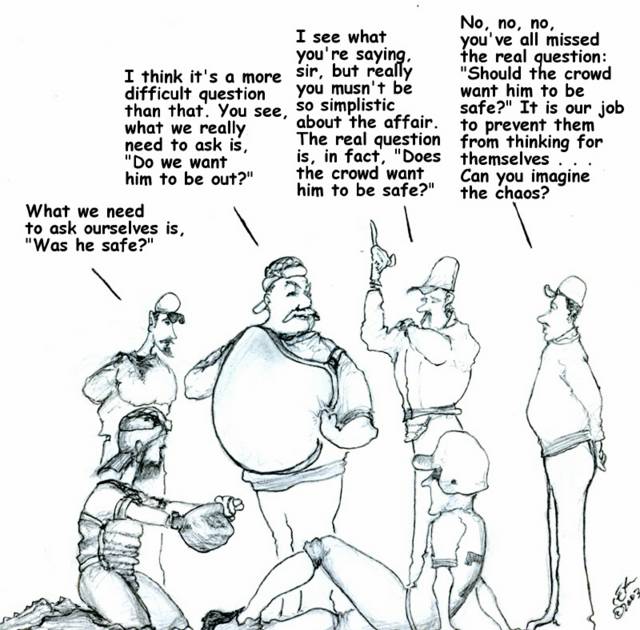
That's the only "rift" I want to see!

Changes in the Restoration Movement

Many of us in the "older guard" and some in the "not so old guard" are concerned with the changes occurring in the Restoration Movement. I've been watching things for a long time now. As a "sort of" faux historian, I've found it an interesting exercise to think about what's happening.

We're concerned because the place of baptism in the "plan of salvation" seems to be shifting away from "baptism for the remission of sins" to "baptism because of the remission of sins". Some say it really doesn't make any difference as long as the believer is immersed! Carl Ketcherside used to say, "God knows what baptism is for whether anyone else does or not!" It does make a difference. One is "sound doctrine" and the other "is not sound doctrine." I think it would be an interesting study to surf through some of our mega-church web sites to see what they actually say about baptism and the "plan of salvation." Hmmmmm! Maybe I'll do that!

We concerned about changes in leadership emphasis. This shift reflects what is going on in the evangelical world per se. Historian David F. Wells says that theology has been pushed to the periphery in evangelical churches and replaced with management. Ministers who used to be biblically literate and theologically sound are now trained to be managers. A lot of ministers in our mega-churches, with few exceptions, couldn't consistently preach biblical sermons if they didn't borrow (I won't use plagiarize because I do it too) sermons from others. Most ministers today are equivalent to CEOs rather than biblically centered with the intent to faithfully teach the Word of God in all its fullness. Let me say it: those who preach Baptist sermons without discerning the theological and philosophical differences will eventually be Baptists. (That's not an indictment of Baptists; they are brothers with whom I differ on some really important issues. I'm still mad about how the Redstone Baptist Association treated Alexander Campbell :0).

The whole shift to a leadership/management emphasis started back in the 1970s when The Christian Standard took a whole year to emphasize the importance of leadership in the local church. Some of our brotherhood biggies decided our churches weren't going anywhere because we lacked leadership in the pulpit and in the "board meetings." Then in the early 1980s, if I remember right, a self-appointed ad hoc committee called for a meeting in St. Louis to see what could be done to get the Restoration Movement "on track." I noticed that of those invited, by far the majority represented the left side of the brotherhood -- what C.J. Dull called the "Old Conservative Disciples." I was a bit ruffled by this, but the meeting eventually resulted in the "Open Forum," which really wasn't open because it was "by invitation only."

During the 1970s and 1980s there were also a few on the fringe who called for the North American Christian Convention to become a delegate convention. I have a copy of an anonymous letter calling for that very thing. The letter even went so far to suggest that Leonard Wymore become the first president due to his wide acceptance in the brotherhood.

Today there are troubling signs that the North American Christian Convention is changing its purpose to appeal to and meet the needs of the "professional clergy." In my view, the convention has always been run by an oligarchy but the "select committee" or the "Board of Stewards" has gotten even more select and few, if any, represent the perspective of the smaller more conservative congregations that make up the lion's share of the brotherhood. The convention is rapidly becoming the convention of the mega-church leaders. Each year these leaders become increasingly unresponsive to those who raise uncomfortable questions. In other words, the leadership is quickly becoming a leadership bent on being served rather than serving a constituency. Maybe that's unfair! More accurate is the charge that convention leadership is more concerned with serving a limited contituency -- the mega-church leadership -- rather than the broad constituency that traditionally supported and attended the convention.

That sort of unresponsiveness does not reflect genuine leadership! It is not even good management. If it were a lone voice or two crying out in the wilderness it would be one thing not to respond, but the voices are growing in number and I believe they will be growing in volume sooner than anyone would like.

Quite a few are disturbed about the inclusion of denominational preachers and leaders in camps and conventions. Frankly, I think it is dangerous to present denominational (read "faith only") speakers pulpit-time in venues where evangelism is expected to take place. Christian Service Camps where it is hoped young people will make decisions do not need the confusion created by a denominational speaker who calls on them to utter a prayer or raise a hand. Not only is this not biblical, it is reprehensible.

At the same time, I am not too worried about the number of speakers in a convention or seminar setting. Dr. Tom Sharp is a Creationist who stands for biblical truth. He knows the Restoration Movement but is not one "of us." We invited him to Canton for a Creation Seminar. It was not an evangelistic affair and we extended no invitations. Tom stuck to the subject and did a wonderful job. I'd have him back; well, I'd like to invite him to Arizona some time! It was a bit unnerving to hear the preacher from the Mosaic Church in California give a "faith only" invitation at last summer's North American, but I wrote that off because I expected it. Probably most of those who attended the convention did exactly what I did. Of course, those who don't know the difference still don't know the difference but I doubt one sermon did much either way. I've enjoyed Promise Keepers, the National Pastor's Conference, and I read lots of books by denominational guys. I filter out the good from the bad because I know what I believe and why! Heaven help those who don't!!!!

There is a growing concern for where the Movement is headed. I haven't even talked about "corporate sponsorships" at the North American, the dangers of such financial ties and the fact that those who provide the money determine the direction, or other issues rising up among us. I do, however, listen. There is a rising tide of reaction and opposition to what is going on. Brotherhood leaders need to listen and respond before there is another rift. I, for one, do not plan on "rifting." I love people on "both sides of the potential fissure." At the same time, those who raise questions will be considered "stuck in the old ways" and their questions written off as the ravings of a radical "right wing." That kind of treatment will only serve to widen any fissure. And when rifts occur, too many fall into the ditch and are lost. Hows that for mixing all kinds of metaphors???

Monday, August 23, 2004


Jesus teaching and preaching

It's more than terminology

Using "pure speech" was one of the Restoration Movement's primary principles back in the "good old days." We popularized it using various mottos, most of which are long out of style. For example: "Using Bible Words for Bible Things" or "Bible Names for Bible Things." The idea was that using theological or denominational terminology only perpetuated division and sectarianism.

Today, however, language itself has come under fire. Postmodern philosophers maintain that words only mean what we want them to mean. Each individual, we are told, sees things differently and uses words to describe what they see or understand. Since no one can have absolute knowledge of anything, words are only relative to the understanding of the individual. Of course, we use words to describe the words that are only relative thus adding another layer to the mess! If words can't accurately express ideas, then we are left "up the creek without a paddle" and genuine communication is impossible.

I think it is amazing that God chose to communicate with us using words. He said that "in the beginnng was the Word." We understand that means Jesus for the Apostle John tells us a bit later in John 1 that "the word became flesh and dwelt among us." Nonetheless, God did communicate often (not always) through words. Evidently He is a good communicator because those who heard Him understood Him.

Since God could and did use language to communicate with us, it seems to me that I can trust what he says. Perhaps he picked the right words as he spoke. I think it is interesting that God's written Word was given to us in ancient Hebrew and koine Greek, two dead languages. The word meanings in those languages do not change. Our expression of those languages into English may shift a bit as we speak and write in a "living language" and living languages change. If you don't think so, explain what "swell" means or define a "besom" for me.

When we use terminology foreign to Scripture we add concepts to the Word of God never intended for communication. I might agree with Luther that the book of Romans teaches "justification by faith alone" but saying that conveys a meaning different from what Luther intended. Faith saves you, but as Jack Cottrell explains it saves you at baptism! It wasn't Luther or Calvin who corrupted the biblical language regarding the "link" between faith and baptism, it was Ulrich Zwingli.

Why are so many today hesitant to use the plain biblical language found in Acts 2:38? I was watching an old TV mini-series, "Anno Domini", the other day and even the script writers got Peter's Acts 2 speech right at the 38th verse! (Of course they later showed him baptizing someone by pouring water over his head. I guess they tried to keep everyone happy!) What is so hard about "speaking as the Scripture speaks?"

Our people avoided systematizing theology for a long time without harmful results primarily because they let the Word speak for itself. That's not to say that they didn't use inductive reason to discover doctrinal truth, they did! I think systematic theology is helpful when done accurately. I'd recommend The Faith Once For All" by Jack Cottrell as the best. But you know what? If more Christians would just read the Bible and believe what it says it would solve a lot of our problems.

Sunday, August 22, 2004


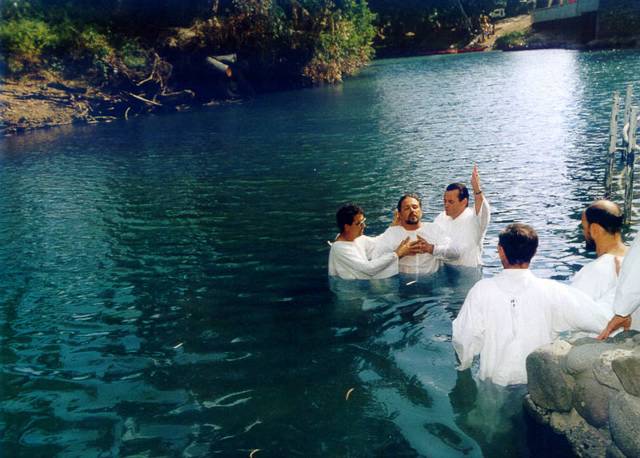
A baptism taking place at the Jordan River where John the Immerser is thought to have baptized Jesus.

Baptism and Change

Dr. Jack Cottrell presented an interesting summary of his Princeton doctoral dissertation in The Christian Standard a few weeks ago. Cottrell argued persuasively that a major shift in the purpose of baptism occurred during the time of the Reformation. For centuries, he says, the church identified baptism as the time God conferred salvation on those who put their faith in Jesus Christ. During the Reformation, Ulrich Zwingli argued that salvation came at the time one puts their faith in Christ thus making baptism an "optional extra" or an issue of obedience.

This weekend's issue of The Christian Standard carried a letter to the editor from a reader affirming the Zwinglian position. Cottrell's reply shed little new light but did serve to reveal his awareness of a change occurring within the Restoration Movement regarding the purpose of baptism. A check of many Christian Church and Church of Christ web sites reveals a softening of the traditional stand on baptism. Baptism is still presented as important and linked to salvation as part of a process. Some have abandoned Restoration terminology to accept the "language of Ashdod." Those who don't understand what I mean here need to do two things: (1) Look it up in the Old Testament. (2) Read some of Alexander Campbell's writings, especially his essay on "pure speech" in the series A Restoration of the Ancient Order of Things that appeared in The Christian Baptist.

I'm not sure why this should be surprising. In 1981, David Filbeck wrote two articles published in The Christian Standard entitled, "The Coming Second Controversy Over Baptism." As early as 1974, John Greenlee, who was preaching at the West Side Christian Church in Wichita at the time, wielded his pungent, often sarcastic, pen to warn the movement that change was coming. In a "Reflecting on the News" column in the April 7, 1974, Christian Standard Greenlee warned that once the threat of compromise came from the left during the Open Membership controversy but the next threat would come from the right. He identified "the right" as contemporary evangelicalism. It has taken a bit over 30 years, but the reality has come upon us as more and more congregations opt for the Zwinglian approach to the place of baptism.

What's worse, this isn't just true in the instrumental churches. Non-instrumental churches are jumping ship for a swim in evangelical waters. Take a look a the web site for the Oak Hills Church. For all intents and purposes, Max Lucado has worded their material on baptism so it no one could take offense. Not only that, but it looks to me like the Oak Hills Church practices what we called Open Membership back in the 1930s through the 1950s. You don't have to be immersed to be a member of the Oak Hills Church, but you do if you want to become an elder or a teacher. Didn't the Disciples try that?

Well what is to be done about it? The truth is: nothing! A few antagonistic brethren could make a stink, create a fuss, and start a new division I suppose. So we could have a "faith only Christian Church and Church of Christ" and a "baptism is for salvation Christian Church and Church of Christ." That would make a lot of sense to the rest of the world now wouldn't it. As a fellowship of independent congregations, there is no structure or belief statement to which all must agree. The only thing I can do is teach the Word to the best of my ability, to love my brethren who are in error (and that's everyone, including me). I don't have to water down my teaching to fit in and my brothers in Christ don't answer to me. I'll argue with them, debate them, challenge them, correct them, but I'll also be open to correction and maybe -- just maybe, we'll all grow in our understanding of each other and God's Word.