Saturday, August 28, 2004

How stuff happens!

Some people have the idea that Roman Catholicism and Greek Orthodoxy were thought up by a bunch of guys in a back room smoking stogies and drinking booze. Well, er, some of those guys did take a sip or two, I'm sure. After all, Paul told Timothy to take a little wine for his stomach's sake.

At any rate, we want to see changes in the church -- particularly changes we don't like -- resulting from the evil desire to distort the church. Now I will be the first to admit that Satan is a deceiver, and he often deceives good people and the results are catastrophic. But I submit you that those who instigate change, even hurtful change, don't always do so because of bad motives.

Let's think about this for a moment!

It is clear from the New Testament text that elders led the early church, particularly after it moved out into the wider Roman Empire. Paul told Timothy and Titus to "ordain elders in every city." Church historians almost universally acknowledge two classes of leadership in the early church:
    1. Apostles, Prophets, and Teachers.
    2. Bishops, Elders, and Deacons

Consider the second group, the leaders established in the local congregation. I believe Scripture tells us the Bishop and the Elder were synonymous and each congregation had more than one. By the end of the first century, there was a move to elevate one of the Elders to the position of Bishop. We see this in a few of the letters Ignatius of Antioch wrote while on his way to Rome to die a martyr's death. The elevation of one individual puzzles historians because Ignatius was from the Antioch church and undoubtedly knew Paul. Why would he counsel elevating one individual and use the term Bishop to designate him? Ignatius made the suggestion to meet a need. Persecution and the proliferation of false doctrine made strong and decisive leadership essential in a congregation. When persecution comes, a church can't afford to take the time to defer to a college of Elders to determine what to do. Leadership invested in one individual is far more efficient. I don't think Ignatius realized his suggestion would eventually result in the full-blown hierarchy of the Catholic and Orthodox Churches! The suggestion carried with it "unforeseen consequences" he could not identify from his vantage point in history.

Another example can be seen in the development of Creeds. The earliest church required a simple statement of belief, "I believe that Jesus is the Son of God." Before long, the statement enlarged to profess belief not only in Jesus, but in God the Father and the Holy Spirit as well. Through the centuries successive Creeds expanded on the original simple statement of belief. Why? In each case, an expanded Creed was written to deal with rising false doctrine challenging the church. Credalism led to sectarianism and division down the road. What was intended as unifying became devisive. Division was an "unintended consequence" of creedalism, but the Creeds were written with the best of intentions.

I bring all of this to your attention to remind you that some of the changes I've bewailed in this blog do not always arise from the hearts of evil men determined to subvert the brotherhood. Some of those receiving the harshest criticism as "abandoning the faith" or "denying the validity of the Restoration Movement" seriously and conscientiously believe they are doing the right thing. They accept the Great Commission and honestly desire to win men and women to Jesus Christ. While I sometimes disagree with the results -- maybe because of my interest in history I can see the potential for "unintended consequences" -- and their thinking, I do not want to disparage their motives or intent. I can't see into the heart, but I personally know many of those I criticize and know them to be men who love God, love the brotherhood, and love me.

I constantly try to remind myself of what I have just written. I call upon all my brothers in Christ to constantly submit their teaching, methodology, and motivation to the Word of God. I have to ask myself if I want to glorify self or Jesus. Perhaps we all need to ask ourselves that and try to be a little more honest than we've been.

Friday, August 27, 2004

Transformed or Conformed?

Visit Saddleback, North Coast, Willow Creek, Maryland Community, any Vineyard Community Church, or any other of hundreds of evangelical churches and you discover remarkable conformity in worship style and methodology. When my wife and I attended a Presbyterian Church in Franklin, KY, without our daughter and son-in-law, I was struck by the fact that the service was virtually identical to any of a thousand other contemporary services. Oh, I forgot, we did recite the Apostle's Creed in that service. You'll find the same kind of conformity in nearly all Christian Churches and Churches of Christ; especially in our mega-churches.

Pick up brochures from each of these congregations and you will find conformity in programming, statements of belief, organizational structure and the like. In the statements of belief you'll find basic statements about the Trinity, Deity of Christ, Virgin Birth, and the Holy Spirit. Statements on how one is saved are also similar with an emphasis on faith, repentance, confession (sometimes put as a "sinner's prayer"), and baptism. With few exceptions, statements about baptism are nebulous at best. In non Restoration Movement congregations, statements about baptism are phrased as "a symbolic act which testifies to what the Holy Spirit has done." These congregations, as does Saddleback for example, link baptism to membership in a local congregation. Statements found in Restoration Movement Congregations are also nebulous presenting baptism was a "symbol of what the Holy Spirit accomplishes." In some cases, baptism is seen as part of "a process" that brings one into fellowship with Christ and the church. I didn't surf the net as widely as I'd have liked, but I found only one mega-church with a statement that is even close to the biblical view that baptism is the "time" when one is regenerated and brought from Satan's kingdom into "the kingdom of His Dear Son."

Two things need to be said here. (1) Many evangelicals understand perfectly the mode and purpose of baptism. George Beasley Murray's magnificant study on baptism made that quite clear. More and more evangelicals, when doing theological writing -- which is rare! -- sound increasingly like Restorationists. To say from the pulpit or to put in writing in their congregation what they have come to believe would put them in a difficult position with their members who are so steeped in evangelical traditions they would react negatively. (2) Restorationists, once convinced that baptism was the point where one met the blood of Christ, now flee from that position. Alexander Campbell stubbornly held to the believe that regeneration occurred at baptism although he did not believe in baptismal regeneration (see essays in the 1833 Millennial Harbinger). Campbell believed the Holy Spirit (God) did the regenerating, not the water.

To make baptism seem more palatable, our preachers have put baptism into the midst of a process. In the new view, no part of the process should be distinguished from the other. An analogy is made to marriage. When is a person married? At the engagement? At the conclusion of the vows? When the proclamation is made? When the documents are signed? When the relationship is consummated on the marriage bed? We don't know, we're told, but we all rejoice. This is a kind of "spiritual agnosticism." It suggests we don't know when salvation occurs -- at the moment of faith, the moment of reprentance, the moment of confess, the moment of baptism? Since we can't know, we should just rejoice that we have a new member in the family of God.

This is just drivel! It is an attempt to soften the historic Restoration Position in such a way as to make it palatable. It is conformity to the evangelical world so we don't seem "out of it" or "strange" or "wierd" or a "cult." If I remember correctly, Peter did say, "Repent and be immersed every one of you in the name of Jesus Christ for the remission of sins and you shall receive the gift of the Holy Spirit" (Acts 2:38). Paul did write, "You were buried with Christ by baptism and raised with him to walk in newness of life" (see Romans 6). Readers should also study carefully Colossians 2:12-13. It doesn't take a genius to see that baptism is the point when all the blessings promised through faith in Christ are bestowed upon a penetent believer. Again, the water doesn't wash you clean, the Holy Spirit does, but regeneration occurs at the time of one's baptism into Christ.

Too many just want to be accepted. They want to be like everyone else. There is a kind of religious conformity at work that results in a dulling of sensibilities. The result is a dumbing down that denies the authority of Scripture, the real work of the Holy Spirit, and the importance of discipleship. Paul said we should be transformed by the renewing of our mind -- our mind -- not just the conformity to current religious trends that excite the emotions and senses of those around us.

Thursday, August 26, 2004


The caption says it all!

The search for respect

I get those e-mails suggesting I'm old because I can remember Blackjack gum, Studebaker cars, and nickle ice cream cones. Okay, so I'm a dinosaur. Just because I was born during World War II doesn't mean I have Alzheimer's disease and am "out of it." There was a day when wrinkles and gray hair earned you some respect. It still does in some quarters of the globe. Now those of us "older than dirt" are much like Rodney Dangerfield: "we don't get no respect."

Speaking of respect! I rejoice that the Restoration Movement is gaining in respect in the broader religious world. I'm tickled pink that we have so many congregations numbering over 1,000 in worship with more joining the group every year. I am excited by the number of baptisms being reported. The emphasis on reaching the lost rather than enticing Baptists away excites me, too. (We have enough trouble with new Christians and their strange ideas let alone trying to deal with Baptist theology. We've already got enough of that!) It is good to be recognized as the second fastest growing "denomination" in America. It is encouraging that most groups no longer label us a cult like they used to, although I bet there are a few judgments like that under their breath.

David F. Wells, in his book Whatever Happened to Truth?, suggests evangelicals have given up theology in favor of popularity. He argues that when public admiration for the "clergy" declined, ministers began searching for ways they could regain lost respect. Since religious leaders no longer had a corner on theology (every man has his own theology), let alone a corner on the truth, they sought respect through professionalism. That search for professionalism in the ministry meant that churchmen had to become specialists in areas other than theology. So they became "church growth specialists," "counseling specialists," or "administrative specialists."

Some of that is probably true. At the same time, I think I know the hearts of some of our mega-church leaders. They are concerned with relating men and women to Jesus. Sometimes I think their methodology and theology are a bit suspect, but I think they mean to do the right thing. They are on a mission -- a mission believed to be God-given. It is a mission drawn from the words of Jesus in Matthew 28:18-20. Sadly, however, there has been tremendous emphasis on the first part of that mission and little on the last. Too many are content to baptize (for whatever reason), but few are focused on discipling the new Christian to obey all that Jesus commanded them. As a result, they have bought into Maslov's Hierarchy of Needs thinking they first need to meet their social and relational needs when the real problems lie far deeper into their very belief system and worldview. New Christians need to do more than fast for a "spiritual high," they need to believe the tenets of the "faith once and for all delivered to the saints."

In my opinion, genuine respect doesn't come through conformity or compromise. It doesn't come because we're the best at preaching "relevant," which is usually interpreted as some form of self-help methodology. Real respect comes when you are able to show that what Christ did is more than "relevant", it is "eternal." It does intersect with contemporary life but it has eternal significance.

Oh, real respect may never come this side of heaven. But Jesus said, "Beware when all men speak well of you." I guess I'm more concerned about hearing, "Well, done good and faithful servant. Enter into the joy of the Lord." How about you?

Wednesday, August 25, 2004


'Nuf said!

On the ministry

We have long struggled with the role of ministry in the Restoration Movement. For years, we treated the paid ministry as a "hireling," something Alexander Campbell despised. More recently, however, the ministry has been elevated to a position of prominence and they are seen as "the leaders" of congregations. In our larger churches, the role of the elder has declined to the point where they "make five percent of the decisions" -- the really important ones -- and leave the daily running of the church, including operational decisions, to the paid ministry. In one sense that reminds me of what Ralph Johnson, one of my professors at Nebraska Christian College, used to say. He said he made the really big decisions in his family but his wife made the rest. So, as he put it, "I decided whether or not to permit Red China into the United Nations or the wisdom of blockading Cuba but she makes all the rest!"

Something is wrong with those pictures! On one hand, the hireling minister, like a hireling shepherd, has no stake in the flock and disappears at the first sign of danger. On the other hand, the managers -- that's what they are -- act like CEOs, CFOs, and COOs without regard the biblical function or accountability.

Let's face it, about the only thing the "minister" has that marks him as different from the rest of the congregation is his education. Even that makes little difference today! In the 1800s, the colleges and universities our movement supported reflected Alexander Campbell's educational concept that all education should center on a sound biblical education. Therefore, the Bible was the major locus of truth and all the disciplines bowed before it. As Classical Liberal education filtered into the United States in the late 1800s, that changed because, in the mind of the liberal, the Bible could no longer be trusted. Bible Colleges and Schools of Preaching rose up to continue the emphasis on the importance of biblical truth. From 1895 through the early 1970s most of our Bible Colleges required a major in Bible combined with sufficient liberal arts to give the student a solid foundation in writing, speaking, and understanding. Since the 1970s an increasing number of our Bible Colleges, now often referred to as Christian Colleges, elevated liberal arts requirements and correspondingly reduced the emphasis on sound biblical teaching. Today, several of our colleges have become universities. A student can enroll in one of these schools, get a smattering of Bible, and graduate with a degree in business, education, or counseling. Biblical truth is seen as only one of many different sources of truth and sound doctrine has been moved far to the periphery.

Those studying for ministry in our colleges no longer need a strong biblical foundation for graduation. They learn to become managers/leaders. Read that as knowing how to start churches and appeal to the masses so they can build a big church. In my view, biblical truth is taking the rear seat on the bus and is no longer a point of emphasis. Oh, there are a few exceptions. Boise Bible College claims to be a "Classical Bible College" devoted to preacher training. Cincinnati Bible College and Seminary, a school once noted for its sound doctrine and conservative stance, now graduates students who are as much at home in Young Life as they are in a Christian Church or Church of Christ. That's probably a bit unfair, but it might be a worthy experiment to ask all the graduates of our Bible Colleges to explain their understanding of how a person becomes a Christian!

Maybe its time we began looking at the Scripture again to define the role of the minister and the elders. In a strange twist of fate, it was Bob Smith, a Baptist (shudder), who helped me see that one way to look at biblical ministry is to see the eldership and paid ministry as a team. Each elder should function in some phase of ministry, an area which best suits that individuals ability. Those who labor full time in their ministry should be supported so they can do their work (Paul dealt with this in one of his letters to Timothy). The others should do their ministry until such time as it demands their full attention then they too should join the ranks of the financially supported. In my view, these men should arise from within the congregation. One role of the minister/elder is that he "be apt to teach." Wouldn't it make sense that one role for the "paid guy" should be the training and educating of the men of the church so they could develop ministry? (I think Paul told Timothy that what he learned he should commit to others so they could, in turn, pass it on to others.)

Now in one sense, we've done this, but we've done it with paid staff. Let's face it, in most mega-churches, the ministerial staff performs the function of elders (without the ability to refute the gainsayers) and the elders perform the task once relegated to deacons. I'm a big fan of multiple ministries and ministerial teams, but let's recognize that in the New Testament Church the leaders, for the most part, came from within the local body. There were exceptions, to be sure, but the exception proves the rule.

Think about it!

Tuesday, August 24, 2004


That's the only "rift" I want to see!

Changes in the Restoration Movement

Many of us in the "older guard" and some in the "not so old guard" are concerned with the changes occurring in the Restoration Movement. I've been watching things for a long time now. As a "sort of" faux historian, I've found it an interesting exercise to think about what's happening.

We're concerned because the place of baptism in the "plan of salvation" seems to be shifting away from "baptism for the remission of sins" to "baptism because of the remission of sins". Some say it really doesn't make any difference as long as the believer is immersed! Carl Ketcherside used to say, "God knows what baptism is for whether anyone else does or not!" It does make a difference. One is "sound doctrine" and the other "is not sound doctrine." I think it would be an interesting study to surf through some of our mega-church web sites to see what they actually say about baptism and the "plan of salvation." Hmmmmm! Maybe I'll do that!

We concerned about changes in leadership emphasis. This shift reflects what is going on in the evangelical world per se. Historian David F. Wells says that theology has been pushed to the periphery in evangelical churches and replaced with management. Ministers who used to be biblically literate and theologically sound are now trained to be managers. A lot of ministers in our mega-churches, with few exceptions, couldn't consistently preach biblical sermons if they didn't borrow (I won't use plagiarize because I do it too) sermons from others. Most ministers today are equivalent to CEOs rather than biblically centered with the intent to faithfully teach the Word of God in all its fullness. Let me say it: those who preach Baptist sermons without discerning the theological and philosophical differences will eventually be Baptists. (That's not an indictment of Baptists; they are brothers with whom I differ on some really important issues. I'm still mad about how the Redstone Baptist Association treated Alexander Campbell :0).

The whole shift to a leadership/management emphasis started back in the 1970s when The Christian Standard took a whole year to emphasize the importance of leadership in the local church. Some of our brotherhood biggies decided our churches weren't going anywhere because we lacked leadership in the pulpit and in the "board meetings." Then in the early 1980s, if I remember right, a self-appointed ad hoc committee called for a meeting in St. Louis to see what could be done to get the Restoration Movement "on track." I noticed that of those invited, by far the majority represented the left side of the brotherhood -- what C.J. Dull called the "Old Conservative Disciples." I was a bit ruffled by this, but the meeting eventually resulted in the "Open Forum," which really wasn't open because it was "by invitation only."

During the 1970s and 1980s there were also a few on the fringe who called for the North American Christian Convention to become a delegate convention. I have a copy of an anonymous letter calling for that very thing. The letter even went so far to suggest that Leonard Wymore become the first president due to his wide acceptance in the brotherhood.

Today there are troubling signs that the North American Christian Convention is changing its purpose to appeal to and meet the needs of the "professional clergy." In my view, the convention has always been run by an oligarchy but the "select committee" or the "Board of Stewards" has gotten even more select and few, if any, represent the perspective of the smaller more conservative congregations that make up the lion's share of the brotherhood. The convention is rapidly becoming the convention of the mega-church leaders. Each year these leaders become increasingly unresponsive to those who raise uncomfortable questions. In other words, the leadership is quickly becoming a leadership bent on being served rather than serving a constituency. Maybe that's unfair! More accurate is the charge that convention leadership is more concerned with serving a limited contituency -- the mega-church leadership -- rather than the broad constituency that traditionally supported and attended the convention.

That sort of unresponsiveness does not reflect genuine leadership! It is not even good management. If it were a lone voice or two crying out in the wilderness it would be one thing not to respond, but the voices are growing in number and I believe they will be growing in volume sooner than anyone would like.

Quite a few are disturbed about the inclusion of denominational preachers and leaders in camps and conventions. Frankly, I think it is dangerous to present denominational (read "faith only") speakers pulpit-time in venues where evangelism is expected to take place. Christian Service Camps where it is hoped young people will make decisions do not need the confusion created by a denominational speaker who calls on them to utter a prayer or raise a hand. Not only is this not biblical, it is reprehensible.

At the same time, I am not too worried about the number of speakers in a convention or seminar setting. Dr. Tom Sharp is a Creationist who stands for biblical truth. He knows the Restoration Movement but is not one "of us." We invited him to Canton for a Creation Seminar. It was not an evangelistic affair and we extended no invitations. Tom stuck to the subject and did a wonderful job. I'd have him back; well, I'd like to invite him to Arizona some time! It was a bit unnerving to hear the preacher from the Mosaic Church in California give a "faith only" invitation at last summer's North American, but I wrote that off because I expected it. Probably most of those who attended the convention did exactly what I did. Of course, those who don't know the difference still don't know the difference but I doubt one sermon did much either way. I've enjoyed Promise Keepers, the National Pastor's Conference, and I read lots of books by denominational guys. I filter out the good from the bad because I know what I believe and why! Heaven help those who don't!!!!

There is a growing concern for where the Movement is headed. I haven't even talked about "corporate sponsorships" at the North American, the dangers of such financial ties and the fact that those who provide the money determine the direction, or other issues rising up among us. I do, however, listen. There is a rising tide of reaction and opposition to what is going on. Brotherhood leaders need to listen and respond before there is another rift. I, for one, do not plan on "rifting." I love people on "both sides of the potential fissure." At the same time, those who raise questions will be considered "stuck in the old ways" and their questions written off as the ravings of a radical "right wing." That kind of treatment will only serve to widen any fissure. And when rifts occur, too many fall into the ditch and are lost. Hows that for mixing all kinds of metaphors???

Monday, August 23, 2004


Jesus teaching and preaching

It's more than terminology

Using "pure speech" was one of the Restoration Movement's primary principles back in the "good old days." We popularized it using various mottos, most of which are long out of style. For example: "Using Bible Words for Bible Things" or "Bible Names for Bible Things." The idea was that using theological or denominational terminology only perpetuated division and sectarianism.

Today, however, language itself has come under fire. Postmodern philosophers maintain that words only mean what we want them to mean. Each individual, we are told, sees things differently and uses words to describe what they see or understand. Since no one can have absolute knowledge of anything, words are only relative to the understanding of the individual. Of course, we use words to describe the words that are only relative thus adding another layer to the mess! If words can't accurately express ideas, then we are left "up the creek without a paddle" and genuine communication is impossible.

I think it is amazing that God chose to communicate with us using words. He said that "in the beginnng was the Word." We understand that means Jesus for the Apostle John tells us a bit later in John 1 that "the word became flesh and dwelt among us." Nonetheless, God did communicate often (not always) through words. Evidently He is a good communicator because those who heard Him understood Him.

Since God could and did use language to communicate with us, it seems to me that I can trust what he says. Perhaps he picked the right words as he spoke. I think it is interesting that God's written Word was given to us in ancient Hebrew and koine Greek, two dead languages. The word meanings in those languages do not change. Our expression of those languages into English may shift a bit as we speak and write in a "living language" and living languages change. If you don't think so, explain what "swell" means or define a "besom" for me.

When we use terminology foreign to Scripture we add concepts to the Word of God never intended for communication. I might agree with Luther that the book of Romans teaches "justification by faith alone" but saying that conveys a meaning different from what Luther intended. Faith saves you, but as Jack Cottrell explains it saves you at baptism! It wasn't Luther or Calvin who corrupted the biblical language regarding the "link" between faith and baptism, it was Ulrich Zwingli.

Why are so many today hesitant to use the plain biblical language found in Acts 2:38? I was watching an old TV mini-series, "Anno Domini", the other day and even the script writers got Peter's Acts 2 speech right at the 38th verse! (Of course they later showed him baptizing someone by pouring water over his head. I guess they tried to keep everyone happy!) What is so hard about "speaking as the Scripture speaks?"

Our people avoided systematizing theology for a long time without harmful results primarily because they let the Word speak for itself. That's not to say that they didn't use inductive reason to discover doctrinal truth, they did! I think systematic theology is helpful when done accurately. I'd recommend The Faith Once For All" by Jack Cottrell as the best. But you know what? If more Christians would just read the Bible and believe what it says it would solve a lot of our problems.

Sunday, August 22, 2004


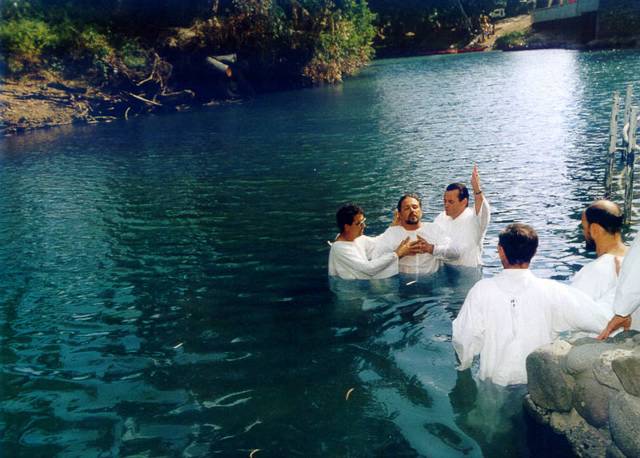
A baptism taking place at the Jordan River where John the Immerser is thought to have baptized Jesus.

Baptism and Change

Dr. Jack Cottrell presented an interesting summary of his Princeton doctoral dissertation in The Christian Standard a few weeks ago. Cottrell argued persuasively that a major shift in the purpose of baptism occurred during the time of the Reformation. For centuries, he says, the church identified baptism as the time God conferred salvation on those who put their faith in Jesus Christ. During the Reformation, Ulrich Zwingli argued that salvation came at the time one puts their faith in Christ thus making baptism an "optional extra" or an issue of obedience.

This weekend's issue of The Christian Standard carried a letter to the editor from a reader affirming the Zwinglian position. Cottrell's reply shed little new light but did serve to reveal his awareness of a change occurring within the Restoration Movement regarding the purpose of baptism. A check of many Christian Church and Church of Christ web sites reveals a softening of the traditional stand on baptism. Baptism is still presented as important and linked to salvation as part of a process. Some have abandoned Restoration terminology to accept the "language of Ashdod." Those who don't understand what I mean here need to do two things: (1) Look it up in the Old Testament. (2) Read some of Alexander Campbell's writings, especially his essay on "pure speech" in the series A Restoration of the Ancient Order of Things that appeared in The Christian Baptist.

I'm not sure why this should be surprising. In 1981, David Filbeck wrote two articles published in The Christian Standard entitled, "The Coming Second Controversy Over Baptism." As early as 1974, John Greenlee, who was preaching at the West Side Christian Church in Wichita at the time, wielded his pungent, often sarcastic, pen to warn the movement that change was coming. In a "Reflecting on the News" column in the April 7, 1974, Christian Standard Greenlee warned that once the threat of compromise came from the left during the Open Membership controversy but the next threat would come from the right. He identified "the right" as contemporary evangelicalism. It has taken a bit over 30 years, but the reality has come upon us as more and more congregations opt for the Zwinglian approach to the place of baptism.

What's worse, this isn't just true in the instrumental churches. Non-instrumental churches are jumping ship for a swim in evangelical waters. Take a look a the web site for the Oak Hills Church. For all intents and purposes, Max Lucado has worded their material on baptism so it no one could take offense. Not only that, but it looks to me like the Oak Hills Church practices what we called Open Membership back in the 1930s through the 1950s. You don't have to be immersed to be a member of the Oak Hills Church, but you do if you want to become an elder or a teacher. Didn't the Disciples try that?

Well what is to be done about it? The truth is: nothing! A few antagonistic brethren could make a stink, create a fuss, and start a new division I suppose. So we could have a "faith only Christian Church and Church of Christ" and a "baptism is for salvation Christian Church and Church of Christ." That would make a lot of sense to the rest of the world now wouldn't it. As a fellowship of independent congregations, there is no structure or belief statement to which all must agree. The only thing I can do is teach the Word to the best of my ability, to love my brethren who are in error (and that's everyone, including me). I don't have to water down my teaching to fit in and my brothers in Christ don't answer to me. I'll argue with them, debate them, challenge them, correct them, but I'll also be open to correction and maybe -- just maybe, we'll all grow in our understanding of each other and God's Word.

Friday, August 20, 2004


Plato

What goes around comes around

As I concluded Robert C. Greer's book, Mapping Postmodernism, I was struck by how much the "modernist"/"postmodernist" debate sounds like philosophical gibberish. Clothe it in whatever wording you choose, it is essentially the same argument philosophers have had since Plato and Aristotle. There is, as quoheleth says, "Nothing new under the sun."

Why would I say this? Well, quite frankly a major form of postmodernism is called antirealism. It states there is nothing real. Reality is what the mind makes it. Therefore, since all of us are different and see things differently there can be no absolutes whatsoever. Another form this takes is that while there may be something there after all, the human mind can only perceive some of what is. Therefore, perception becomes truth for you but it may not be for someone else. We are thrown back to relativism.

Modernists, we are told (and we're not talking about the Modernists of Classical Liberalism), are foundationalists and believe that something is and we can know it. Such knowledge may be imperfect and partial, but it can be studied, investigated, and the information derived is useful.

If I am not mistaken, and I am not a philosopher or even much of a theologian, Immanuel Kant distinguished between the noumenal and the phenomenal. The noumenal was the thing (ding an sich) and the phenomenal is what we perceived. There may well be an aluminum can, but we cannot know the actual can. We perceive the phenomena given off by the can. We can investigate the phenomena, experiment upon the thing and consider the changing phenomena, and test the phenomena until we can make use of the thing. Still, we cannot truly know the thing in and of itself.

Going farther back into history, the church was troubled by the debate over the nominal and the real. This was much the same argument but it preceded Kant by many years.

Plato's concepts focused on the real and the ideal. According to Plato, everything we see, touch, feel or experience in this world is but a poor copy of the actual object located in the ideal realm. Plato illustrated his ideas in his classic on "the cave."

It is the same old argument floating around. Today's version is subtly nuanced in order to fit a world where coping has become increasingly difficult due to the interaction of various cultures and worldviews. So many have come across as always right having truth sewn up and neatly packaged. Those who think they have it all often act in unloving, judgmental, and condemning ways rejecting anyone who disagrees with them. Legalistic, toxic churches have done more damage to the truth of biblical Christianity than one can imagine. Rather than offering loving acceptance followed by patient and persuasive teaching, too many Christians expect total agreement with every assertion.

It is no wonder that so many heathens (and I use that word in a non-pejorative sense) reject the faith. Their honest questions and doubts were rejected out of hand and they were told to "measure up" without giving them an opportunity to seek out the truth. That must change before the church will get much of a hearing.

Wednesday, August 18, 2004


Alexander Campbell

Postmodernism and Restoration

Postmodernism’s approach to truth leaves me a bit cold but I’ve been struggling to understand the paradigm. I found Robert C. Greer’s book, Mapping Postmodernism: A Survey of Christian Options, helpful. Greer presents a spectrum of options ranging from completion rejection of postmodern concepts to virtual acceptance. He agrees that there is an epistemological shift occurring and that Christians need to understand it, respond to it, and adapt their methodology and, to some degree, their message to deal with it. I can identify with the need to adapt methodology but I am uneasy with any suggestion that we should fiddle with the message.

Greer says Christians should comprehend what he calls “the dark side of absolute truth.” Individuals and communities can’t come to absolute truth; they only pass on their perceptions of truth. As a result, when individuals or movements believe they have come to the knowledge of absolute truth, they reject anyone and everyone who disagrees with them. (Note the many divisions within the Church of Christ and Protestantism in general!) Triumphalism, as Greer calls it, eliminate the possibility of Christian unity because those who think they have a corner on the truth will not, to use Restoration Movement terminology, fellowship with those who disagree.

For Greer and other theologians, Christian unity (ecumenism) is important because division hampers the spread of the gospel. Competing truth claims leave the lost confused and more certain that no one can know the absolute truth. If Christians can’t agree, then perhaps the different varieties of Christianity offer no more than Buddhism, Hinduism, Shamanism, Wicca, or any number of other “isms” or heathen belief systems.

Greer offers a solution to the problem which he says is not grounded in the old “modern” paradigm. He calls the “modern” paradigm cogito because it is based in Cartesian logic. Postmodern thought rejects both deductive and inductive reasoning as flawed and rooted in the idea that one can come to absolute knowledge about a thing. Approaching Scripture as if it were a storehouse of dogma defeats the purpose of taking the gospel to a lost world. The old way of reasoning assumes that if everyone accepted certain definitions, they would by applying reason come to complete and total agreement on doctrine and practice. Since that has not happened, there must, he says, be a new approach.

First, Greer suggests that individual believers and Christian communities must give up the idea that their doctrinal system is the absolute and final understanding of the biblical message. His solution: rather than seeing systematic theology as the epitome of absolute truth, Christians must come to realize that absolute truth rests on a Person not propositions. In other words, absolute truth is found only in Jesus who said, “I am the way, the truth, and the life….”

Um, that sounds vaguely familiar!

Second, Greer suggests that individual believers and Christian communities must take a two-tiered approach if they are to communicate effectively with each other and come to unity. He writes, “A two-tiered system is necessary to divide those articles that establish the parameters of orthodoxy (e.g., the doctrine of the Trinity, the hypostatic union) from those articles that merely distinguish the particularities of differing ecclesial bodies within the parameters of orthodoxy (e.g., the mode of baptism, the question of eternal security). At the root, Greer is calling for the church to unite on the essentia. What he does not realize, however, is that some of us would build a different list of essentials than he does.

The idea of seeking unity on the essentials, however, is certainly not a new idea. It dates back to Augustine: “In essentials unity, in non-essentials liberty, in all things love.” If I’m not mistaken, that sounds familiar too.

Third, Greer suggests that individual believers and Christian communities must recognize that faith and knowledge are inextricably linked but one cannot be sure which comes first. He states that the Holy Spirit and the Word are also linked, but says one cannot be certain which comes first. He argues that the Holy Spirit must aid understanding but so does the Word. He stops short of the historic doctrine of illumination, but he comes very close to it. An examination of Greer’s spiritual journey leads me to wonder if he hasn’t absorbed sufficient Calvinism to color his perspective. Since most of the theologians discussing postmodern concepts arise out of theological liberalism or Calvinistic evangelicalism, there are going to be some major issues with those who reject Calvin.

Fifth, Greer suggests that individual believers and Christian communities should return to the ancient creeds as expressions of faith. Greer believes the Holy Spirit guides the church into truth. Thus, the church is ever changing in its structure, methodology, and doctrinal understanding. He states that the Holy Spirit shapes the message for each culture (contextualism?) resulting in the plurality of “faces” the church assumes in each culture.

In my view, this thrusts everything into the realm of the subjective. Of course, that is what Postmodernism does. It questions the validity of objectivity. In Greer’s view, then, everything but Jesus rests on subjectivity.

I think it is interesting that Greer’s suggestions, at least in part, sound like what the Restoration Movement has preached but failed to practice for years. Truth rests in a person. Unity can be found by emphasizing that which is essential.

Alexander Campbell believed that the Holy Spirit worked through the Word for justification and sanctification. In essence, he believed the Word of God was self-authenticating. Perhaps his call to give up divisive creeds and systems of theology and let the Bible speak for itself can resonate in the hearts of our contemporaries. Maybe we need to “preach Jesus” more than we need to “preach baptism,” as important as that is. Maybe there is a need to use biblical language and seek to understand the biblical worldview.

Oh, I forgot, Alexander Campbell was the first to “wed Enlightenment thinking (cogito) to evangelical Christianity.”

Monday, August 16, 2004


The famous Roman Coliseum, where many Christians died for their faith.

Back to the future?

Toleration is one consistent postmodern refrain. Postmoderns insist that since one cannot know or discern absolute truth, it is not possible to pass judgment on competing truth claims. They also assert that "truth" is comprehended through culture. In other words, Western culture shapes one's perception of what is and what is true. Therefore, according to postmodernism, Christianity's concept of god (not capitalized on purpose) may be just that -- a Western construct. Other equally valid interpretations of god arise in other cultures. The god of Buddhism, Hinduism, or Islam are equally valid given the culture in which those ideas arise. Given these ideas, it is politically incorrect for Christians to see their faith as exclusively true.

Early Christianity found itself in a similar situation. Confronted with Roman pluralism, Christians found themselves in conflict with Roman pluralism. Rome's religious policy required recognizing all gods as equally valid. When Roman armies subdued Rome's enemies, Rome assimilated the gods of the defeated enemy into the Pantheon. Rome recognized those gods as the gods of a specific people. Rome recognized Jehovah as "the god of the Jews" and thus assimilated Judaism into the Pantheism. Rome pronounced unrecognized religions as religio illicita (illegal religions) and prohibited their observance.

Rome persecuted first and second century Christians for various reasons: (1) Christianity was new. (2) Christianity seemed unpatriotic. (3) Christianity was secretive. (4) Christianity practiced unsavory rituals (according to rumors). (5) Christianity insisted it was the only true faith and it was universal. Christianity's claim to exclusivity earned it Rome's venom and recognition as an illegal religion.

Rome tolerated Christianity as long as it appeared to be a sect of Judaism. Persecution began after separation from Judaism. Most church historians recognize that Roman persecution did not begin until AD 64. Roman emperors continued persecution almost unabated until the Edict of Milan and the rise of Constantine. Although the intensity of persecution varied according to emperor and region, Christians died by the thousands because of their insistence that their faith was absolutely true. Roman tolerance extended only as far as individuals and Christian communities were willing to privatize their faith and comply with Roman requirements including recognizing the emperor as a god. While some Christians complied, many more refused to bow before Caesar's bust seeing it as idolatry of the worst form. Christians continued their testimony in obedience to Jesus' commission in direct opposition to Roman policy.

Isn't it strange how history tends to repeat? Christians find themselves in a culture much like that of Corinth and ancient Rome. Postmodernism's loud voices call for tolerance, the abandonment of moral absolutes, and the privatization of faith. Believe what you will, say the Postmodernists, but what is true for you may not be true for me. Sounds pretty much like Rome to me!

Thursday, August 12, 2004


Consistent scientific principles enable another NASA launch.

A Way of Knowing

One of my seminary professors once said in class that today's basic problem swirls around epistemology. Epistemology is the study of how we know what we know. He was right!

In the pre-Enlightenment era, the Western world sought universal truth. Plato taught the "real" world was the metaphysical world of which the physical world was a copy. In some ideal realm there was a real chair of which all physical chairs were but copies. Aristotle argued that the real world was knowable through the senses. Neither Aristotle nor Plato would dismiss revelation as a way of knowing. The gods did, on occasion, speak. Scholastics and Renaissance churchmen took up the arguments and continued them but the latter said humans were capable of knowing. Enlightenment philosophes said not only were human beings capable, they could know truth and reality because it was coherent. What was true was consistent with the testimony of the senses and the application of the scientific method.

Alexander Campbell, who Ernst Lee Tuveson said was the first to link Enlightenment thought to historic Christianity made sharp distinctions between fact, faith, and opinion. Fact was what was reality known by one's own senses. Faith was the belief of testimony. Opinion was what you believed without the evidence of sensory experience or testimony. According to Campbell, I know my office chair is real because I am sitting in it. That's a fact! I believe George Washington is buried at Mount Vernon because of the testimony of others (I can't see inside the tomb so I don't know it as a fact). I am of the opinion that God has made the worlds for man to explore (Scripture doesn't say that). Campbell would argue that the Scripture is God's Word to man given by revelation as a testimony to His person and work. He would not deny it was written in a context, but Campbell would say it was written for a purpose.

Today knowledge is either the perception of the individual or developed in community. It is always incomplete and absolute knowledge is impossible. There is enough truth in those statements to make them sound plausible.

As a historian, I have long been familiar with the "historian's dilemma." The dilemma is that if I seek an understanding of space-time events, I must do so through the investigation and interpretation of original documents. These documents may be written testimony of contemporaries, they may be government or church documents and records, they might be bills of sale, trade agreements, and a broad assortment of other materials. If I study the written testimony of those contemporary to the event, I must make allowances for the biases of the authors. Then, too, I must make allowances for my own biases and prejudices. The question is, can I ever know enough to say I know the exact nature of the event being studied? The answer is, No! There is always room for a variation of views. Could I, however, know something about the event? Yes!

Human knowledge on this side of glory is always incomplete and partial, but is it sufficient? Scientists tell us the "laws of nature" are not always as constant as we once thought but they are sufficient for practical use. Every time NASA launches a probe, it assumes on the basis of previous experience that the physical laws governing such a launch are sufficiently constant for them to plot a course to the craft's destination.

Postmoderns call everything into question, but I would argue that while we cannot know everything, we know from revelation, the experience of thousands of Christians whose testimonies we see and hear, and the ultimate coherence of the arguments that we can know "the faith once for all delivered to the saints" is absolutely true. It isn't just true for them. It isn't just true for me. It is true for all who choose to overcome their biases and heed the explicit and consistent testimony of the Word and the lives of others. Isn't that what brings us to faith? Doesn't the Scripture teach us we are "justified by faith"? (See Romans 3, Romans 10:19)

Wednesday, August 11, 2004


Postmodernism

Postmodern Discipleship

I've been reading material about postmodernism over the past few years. I'm not sure I completely understand postmodern thought, but then who does? From those I've read, several characteristics stand out:
  1. Postmodern thought is not linear. As I understand it, that means that the old way of reasoning moved from proposition to proposition to conclusion with each necessarily arising from the previous and beginning from observed reality. Postmodern thought, however, is not necessarily circular. Instead, it receives input from a multitude of sources then draws a conclusion. It would be similar to getting data from random web sites and drawing a conclusion about whatever topic you were researching.
  2. Postmodern thought questions notions of perceived reality. Postmoderns assert that true truth can't be known because truth is a construct of a community. Each individual sees truth from their own perspective and their own biases thus they can never really know what is "out there." But, to coin a phrase popular on TV, "the truth is out there."
  3. Postmodern thought seeks a "kind of" spirituality. Postmoderns argue that science promised more than it could deliver. Furthermore, they react to the "modern" notion that the material world is really knowable and are not predisposed to dismiss that which is meta-physical. Most, however, have no firm conviction of "what is out there." A quote from President Eisenhower is descriptive of postmodernism. Ike said, "You can't go through a war without faith, and I don't care what kind of faith it is." It seems to me that Norman Vincent Peale's idea of putting "faith in faith" would sit pretty well with most postmoderns. This kind of spirituality doesn't need content it just seeks a feeling attributable to something beyond the self.
  4. Postmodern thought distrusts words. Words, they say, only reference other words. This is a product of French deconstruction. I'm not sure I understand all of this. The idea is that individuals use words to describe reality as they perceive it. Therefore, the words selected don't necessarily define what is since what is can't be known. As a result, postmoderns seek a feeling that brings with it a perception of meaning. Perhaps that's why the postmodern generation is so high on the visual media, sound that reverberates in the viscera, and ritual that communicates beauty and purpose without words.

Postmodern thought has far more to it than I've mentioned here. You can see from what I've written that "sound doctrine" is not important to discipleship. Discipleship is no longer seen as the understanding of absolute propositions but is instead a felt spirituality. A major problem with this is a lack of balance. One can practice all of the spiritual disciplines without understanding. To do so can lead to asceticism because you can get "caught up" in seeking after a specific feeling. The law of diminishing returns (is that a modern idea?) pushes toward ever stricter discipline until you have a repeat of Simeon Stylites (a pillar monk). Those who seek a feeling without corresponding content might end up "blown about by every wind of doctrine."

Here's a thought for you. I believe postmoderns are right to state that perception often distorts what really is. All of us have our biases. Mine affect how I interpret historical events. If I report on an automobile accident, I do not tell all of what occurred because I can't know all of what occurred. I see the accident from my perspective and my biases. But to say I can't know all of what happened doesn't mean that I can't know some of what happened. To assert that reality is unknowable because I can't possibly have universal knowledge about reality does not mean that I can't discover some true truth about reality! Furthermore, if God, who can perceive all there is to know about reality (isn't that part of the definition of God?), communicates it to me through words can't I at least perceive part of what he tells me? Isn't it possible that he, who created all that is, might know how to communicate with me through words in such a way as to give me a picture of reality? If so, then it becomes my problem to sort through my biases and my prejudices and my weaknesses and subordinate them to God!

Tuesday, August 10, 2004


Evangelist Billy Sunday preaching on "The Sawdust Trail."

Can pragmatism coexist with sound doctrine?

Can pragmatism and sound doctrine coexist? Today's culture is highly pragmatic. Most of what I've written about here reflects a tension with "what works" and "what's right." I know that sentence sounds like something is wrong just because it works." I don't mean that at all! The problem, as I see it, is that there are those who think that "if it works it must be right." That's not true! At the same time, there are those who think that the reason their church isn't growing is because they "are right" and what they're doing "is right" and "narrow is the way." That's not true either.

I think Thomas Campbell -- yes the one from the early 1800s -- had it right in his Thirteen Propositions published in The Declaration and Address." Campbell strongly believed in teaching the Bible but he recognized that in the life of the church there are those practices that are helpful but not described in Scripture. In the last of the propositions Campbell maintained that "expedients" (things that work) not found in Scripture may be helpful and they are permissible, but -- and this is a big but -- they should never be retained longer than they are helpful.

I do evangelism differently than I did it in the 1960 and 70s when I was first in ministry. I use a modified "101" approach. We invited 53 people to come to our home for a conversation about the church and about what Christ teaches about membership. Fourteen showed up and it was, to the say least, an interesting afternoon. Last Sunday seven responded to the invitation. In prior years I've used the Jule Miller filmstrips, Bible studies in the home, evangelistic calling, evangelistic meetings (for those I couldn't get down the aisle a super-salesman often could). When the "101" approach no longer works, I'll dispense with it. I will do so not because it is wrong, but because it is no longer effective. The Great Commission tells us to go preach the Gospel but it doesn't not specificially tell us what methodology to use.

My quarrel with things as they are is not that we alter methodology in order to become effective. It is that we all too often think that because we do what works we don't need to teach content after folks walk the aisle. There just has to be a balance.

Monday, August 09, 2004

On Leadership and Theology

Historian David F. Wells offers some interesting perspective on the contemporary church. In his book No Place for Truth, I'm told Wells asserts that today's ministers are more concerned with psychology and management than theology.

Most of the preachers I know in our megachurches would dispute that, but not for the reasons you might suppose. They would resist the charge they were concerned with psychology preferring to say they wanted be relevant and meet needs. To the second charge, they would state they were more interested in leadership than in management.

A closer look, however, reveals that the needs addressed usually take the form of marriage counseling, self-image therapy, keys to successful business or decision-making. You can find hundreds of these books, even books from a Christian perspective, on the shelves of countless bookstores. God wants biblically-based homes to be sure, but I have to wonder if one can truly build such a home apart from an understanding of who Jesus is and what he has done in history to redeem the individuals making up a marriage.

Following the lead of such individuals as John Maxwell, most would say there is a world of difference between managing and leading. Maxwell defines management as "the process of assuring that the program and objectives of the organization are implemented" (Developing the Leader Within You, Introduction). He defines leadership as having to do "with casting vision and motivating people." He continues saying that managing is making sure the work is done by others but a leader inspires others to do better work." Now I have to tell you that the difference here is pretty thin. I would think a good manager would inspire people to do a better job.

Let me make a couple of observations before I post today's blog. First,I remember when the Christian Standard magazine spent a year on the importance of leadership in the Restoration Movement. At the end of the year, I don't think much changed occurred in most churches. In those days, most of us were taught that the eldership in a church comprised the leadership. We avoided the "pastor system" as rooted in a false idea of church. I find it interesting that Alexander Campbell preferred the term Bishop in reference to the preacher. Because of what we believed, most of us deferred leadership to the local elders. We tried to "sell" them on our ideas, but if they chose not to accept them nothing happened. It was Bob Smith's (shudden -- a Baptist) book, When All Else Fails, Read the Directions that offered me some correctives. Then a study of church history convinced me that the "Bishop" was, in the New Testament Church, an individual selected from the Presbyters (elders) and given a leadership role in the church. He may well be one of those men worthy of double honor because they give all their time to God's work (1 Timothy 5:17-18). I am convinced that at the very least, the minister should be elder qualified and an elder. If he were an elder, then he would be able to legitimately use the title "Pastor." As an elder among elders, his role would be far better defined and his qualifications understood.

Second, as long as we teach only psychobabble from our pulpits we will make shallow Christians who believe they are disciples because they build a tolerable marriage or have a positive self-image (and perhaps are even self-actualized). Please do not get me wrong! I do believe there are biblical principles that apply to building a positive self-image, sound mental health, and a successful family -- and they should be preached! What I am begging for is a better balanced preaching program that supplements what people hear in a small group (often more psychobabble but from those who don't know anythng about it) or a Bible class. I'm talking about preachers who aren't afraid to boldly teach what the Bible says about God, the authority of Scripture, Jesus' propitiation (look that one up), the place and nature of baptism for the remission of sins, and a host of other issues comprising sound biblical doctrine.


Sunday, August 08, 2004


A Muslim family studies the Qu'ran.

Taking religion seriously

Terry Mattingly's "Get Religion" blog (http://getreligion.org) today presented some interesting thoughts about commitment to faith. Terry pointed out that the one thing today's media and government sources don't want to do is to suggest Muslim terrorists might be working from their faith construct. Nearly everyone in the "politically correct" crowd says terrorists do not reflect true Islam. Instead, terrorists, we are told, represent the lunatic fringe -- the "fundamentalist" version of Islam.

What a crock! Islam is not now and never has been a "peace loving" religion. The Qu'ran is filled with surahs suggesting the "infidel" (that's us, folks) must be converted or killed. When Islam rose and began its conquest in the 700s, its means of conversion was not persuasion -- it was the sword. Now I'll admit that some misguided Christians also used the sword. Charlemagne "converted" thousands with a sword held to the neck of his defeated enemies and they responded, "No one ever explained the gospel to me so clearly." Most early Christians carried the Christian message with the understanding that "faith comes by hearing" (Romans 10:17). Islam over ran Arabia, North Africa, much of the Middle East, and eventually Constantinople and the Byzantine Empire fell to its armies. Islamic rulers permitted Jews and Christians to coexist with them as long as they paid an annual indemnity and did not proselyte or evangelize. Many nominal Christians soon found social and economic advancement came only with conversion.

Today's Islamic terrorists are not interested in merely influencing western policy. Sure, they don't want the west supporting Israel, paying bottom dollar for oil, and keeping infidel troops in Muslim lands. They do want to take their false religion to the western world. They are being remarkably successful at it, too.

The point I really wanted to make is the fact that most Americans can't see the source of the real threat because secularism, naturalistic worldviews, and compartmentalizing of the faith has crowded out genuine Christianity. Christianity, for most of us, requires little commitment and certainly no sacrifice. Today's version of Christianity appeals to the "me-ism" of the day in spite of all the talk about "it's not about you!" For most church attenders, it is all about them. Even conservative Bible-believing churches with expectations don't really expect genuine discipleship. They teach it is "nice for nice people to be nice." If you attend, cough up for the coffer, and maybe get your weekly dose of therapy in a small group you are a "real Christian." As long people feel good and "feel God" (meaning that the bass is so loud it vibrates your bones) then they are happy in their nice churches.

If Islamic "fundamentalists" can commit religious suicide to further the interests of their god, what should Christians -- who know the one true God -- be willing to give up for Him? That's something to think about!

Saturday, August 07, 2004

On the writing of sermons

I just finished preparing my outline from the manuscript I completed earlier this week. I'll preach it tomorrow. Nothing I've ever done improved my preaching more than studying the Scripture, hearing other messages on the subject, and writing a message out. I am not terribly original in my preaching, but I try to make a sermon fresh, relevant, and appropriate for my hearers. Writing it out permits me the luxury of reading and rereading it to make sure it fits. By outlining it, I take the basic notes into the pulpit to keep me on target but it also gives me freedom to slightly change the wording.

After all I've said this week, you may be wondering why I would be so concerned with relevance. Sound doctrine is important and must be taught, but truly relevant messages build on sound doctrine. Right now I'm preaching through the letter of James. James doesn't say a whole lot about Christology, soteriology, or pneumatology. He does, however, discuss the importance of not showing favoritism because of position or standing. Had his readers not understood the doctrine of grace, I seriously doubt if his counsel would make much sense. His admonitions concerning "managing the mouth" must have some basis in recognizing that this can't be done without assistance from the indwelling Holy Spirit. I could go on. I think it is interesting that every discussion of eschatology in Scripture results in teaching about practical living.

The sad fact is, however, that we are trying to build "houses of practical teaching" on sand. There must be BOTH (pardon my shouting) sound doctrine and practical admonition.

Friday, August 06, 2004

The Transition of Max Lucado and the Oak Hills Church of Christ

I first heard Max Lucado at an author's breakfast in Boise, Idaho. I think it was his first book tour. A Christian bookstore in Boise invited community ministers to hear him. As a minister in the non-instrumental Church of Christ, Max did not join in the singing at that occasion.

Over the years, Max's writing was widely accepted and acknowledged. I have always appreciated his work and have read several of his books and approved others as study material for various Bible classes. I've often cited him in messages and quoted him in material I've written.

A bit better than two years ago, a controversy arose in the church about the nature and purpose of baptism. Several families objected to the explanation of how to become a Christian posted on the church's web site. On that section of the web site, I had indicated that an individual is saved by grace, through faith, at baptism, for good works. It is my conviction that the Bible clearly teaches this and that it is the historic position of the Restoration Movement. Those who objected insisted they were saved before baptism and that baptism was for membership in a local congregation.

This controversy led to some research to see how other Restoration congregations stated the place of baptism. One of the places searched was that of the Oak Hills Church of Christ in San Antonio. At that time, the web site carried a full explanation of the place of baptism as far as they were concerned. (A search today reveals that this material is no longer easily accessed.) At that time, individuals could become members of the Oak Hills Church of Christ without being immersed. Such members, however, could not be leaders or teachers without being immersed. This struck me as a bit strange because independent Christian Churches and Churches of Christ had endured substantial tension and division early in the 20th century over "open membership" -- the receiving of the "pious unimmersed" into fellowship. The Oak Hills statement seemed to indicate that a church among the non-instrumental wing of the movement had adopted an open membership policy. Lucado's message was fairly typical, but he had softened the traditional position that insists that baptism is for the remission of sins (Acts 2:38). His message sounded very much like that heard in most evangelical churches today.

About six months later, a couple from the church returned from a visit to San Antonio where they visited the Oak Hills Church of Christ. They brought with them printed material indicating that the church was making some dramatic changes. First, the church was changing its name from the Oak Hills Church of Christ to Oak Hills Church. Second, they were adding two worship services that would be accompanied by instrumental music. Those who visited were excited about the changes because they saw in those changes a growing acceptance of the segments of the Restoration Movement from which the Oak Hills Church had long been separated due to differences over the use of instrumental music.

The next step in the transition of the Oak Hills Church and Max Lucado came when he was quoted in Christianity Today and other religious news periodicals as no longer believing that baptism was essential for salvation.

A trip to the current Oak Hills Church web site at www.oakhillschurchsa.org reveals that the congregation has taken additional steps away from traditional Restoration Movement positions per se let alone the traditional positions of the non-instrumental wing of the movement. The current statement of beliefs is written carefully so as to avoid taking a strong stand on the importance of the place of baptism. In one sense that is good, because many in the movement have made baptism the "end all, be all" of salvation leading to the charge of "water regenerationists." However, it seems to be a statement that can be interpreted any number of ways. Those holding the traditional view will not find it offensive (I just demonstrated that above), but those who come from a "faith only" background will not find it difficult to accept either!

There is one other statement in the Oak Hills "creed" that I find a bit disturbing. The last sentence in the section on salvation says, "Those who truly believe are secure and safe in God’s grace and cannot lose their salvation" (John 10:27-29). This statement, when carelessly read, can mislead. The statement seems to support the view of those who hold to "perseverance of the saints," the old "once saved always saved" view. Those who have heard all their lives that "once you're saved you're always saved" would have no difficulty with this statement, but I do not think the statement is saying what they believe. There is a very fine line between assurance of salvation and "once saved, always saved." The former is biblical, the latter grows out of Calvinism.

In my view, I wonder if the changes in practice and wording grow out of a renewed understanding of biblical authority or if it is simply doing what is practical (pragmatic) in appealing to a wider audience. I would be euphoric if those who once ostracized me because I worshiped with instruments now recognized the fallacy of their logic in interpreting Scripture and no longer believed use of musical instruments was a sin. I am less than ecstatic because it seems like the abandonment of principles once held dear results from pragmatism rather than biblical authority.

How do you see it?

Thursday, August 05, 2004

Discipleship and assimilation

I have in my library, or did have before I moved from Ohio to Arizona, a number of books on the process of assimilation. In fact, I had a rather large notebook that outlined the steps churches could take with new members. The structure looked different but the philosophy was the same as that of Saddleback Church in California. Rick Warren describes assimilation as moving people from the outer circle of the community to the innermost circle he calls the core. The idea is that assimilation takes place in a series of steps as individuals move from attenders, to membership, to involvement in a small or mid-size group, to service, then finally into leadership. It is a good model and usually works well when it is worked properly.

Warren structured four seminars to help move people from the outside in. His second seminar emphasizes maturity and/or spiritual growth. This seminar encourages new Christians and new members to establish a daily quiet time with Bible reading and prayer, time for Bible study, and practice the tithe. It is a start and should help people grow as disciples. His third seminar focuses on service encouraging new believers to get active in some avenue of Christian service. Again, this is a good start. Without accountability structures, however, these may become easily attended seminars with little practical results. One can hear they ought to read the Bible and even receive a Bible-reading plan and never read the Bible.

Church leaders often think that because someone has attended a seminar or accepted a task they are assimilated. The leaders in the church I served in Ohio looked at two things: (1) Did new members attend a Bible class? (2) Did new members take a task assignment?

All of that reflects a good start in assimilation. Do we really think, however, that someone who attends a seminar or takes a task is really growing in their faith? In my opinion, assimilation and discipleship may work at cross purposes. If someone is satisfied with their spiritual understanding and growth because they have "jumped through the hoops" and do something in the church, are they really growing in their relationship to Christ? I don't suppose we can ever know for sure!

Randy Frazee and the Pantego Bible Church devised a Christian life inventory geared to help measure individual spiritual growth. Do a search on "The Connecting Church" or go to www.pantego.org and you will find out about this instrument. Maybe it is time to stop assuming that spiritual growth and deeper discipleship is occurring and it is time to do some measurement. If the church does not expect and encourage spiritual growth in its members, it won't happen. In addition to assimilating members it is important to emphasize an expectation of spiritual growth. Without it we will continue to get the results we've always gotten.

Wednesday, August 04, 2004

Discipleship is a lifestyle

We make a mistake when we see discipleship as a point of conversion. For a long time, I equated "becoming a disciple" with "being baptized and received into church membership." While I will not judge the reality of an individual's relationship to Jesus, it is obvious that many who profess Christ and are baptized really do not entrust themselves to him in genuine faith. Jesus said, "Why do you call me Lord, Lord, and do not do the things I commanded you? Practice does not match profession!

A disciple is one who seeks to become like their teacher. In ancient Judaism, the rabbis had their disciples. It was understood that the disciple wanted to replicate in themselves the life of their teacher. They wanted to think like their teacher. They wanted to act like their teacher. They wanted to teach like their teacher. They wanted to live their lives as their teacher would live it if he were them. It was a struggle for each disciple attempted to integrate what they saw and heard with their personalities, interests, perspectives and desires. They had the advantage of spending quality and quantity time with their rabbi. Jesus' disciples were with him 24/7 and they could see him, study him, touch him, and learn from him (see 1 John 1:1f). Biblical discipleship is a relationship so intimate that the lifestyle of the teacher is integrated with the life of the disciple.

By practice rather than profession, today's church teaches that faith, confession before an audience of sympathetic hearers, and baptism makes one a disciple. You will notice that I left out repentance. I did so on purpose. I do not think we sufficiently emphasize repentance nor am I certain we understand it.

In the New Testament, repentance means "a change of mind that leads to a change of life." Alexander Campbell believed that you may profess a change of mind without a corresponding change of life. In an essay in the 1833 Millennial Harbinger, Campbell stated that true repentance indicates not only a sorrow for wrongdoing but calls for restitution as well. If a person professes repentance but demonstrates no corresponding effort to make right his previous wrongs, how can one's repentance be considered genuine? We are told that the old law was a tutor to bring us to Christ. In the old law, we are told that we should not steal. In the provisions of the Mosaic Law, the thief was to restore what was stolen plus an indemnity of five percent. The illustration for the believer is that when we come to Christ we seek to make right what we did wrong. We seek to make restitution.

We tend to treat Christianity casually as if it were equivalent to joining a club. I was a Rotarian for years and I found the fellowship and friendships stimulating. I believed in the principles of Rotary and approved its worldwide benevolent works. Many Rotarians joined because it helped their business. Rotary, however, did not call for any change of lifestyle. The current trend in the church is to "sell" the idea that Jesus can help one build a successful marriage, family, or business. As long as these principles can be communicated in an attractive and palatable fashion without requiring much commitment they are accepted. When someone else presents a better product such individuals leave.

Discipleship requires a transformation of life. It is a process that begins when one "enrolls in the school of Christ" and continues until death. It calls for more than casual attendance at worship or small group. It calls for establishing a daily relationship with Jesus through Bible reading, Bible study, prayer, and the practice of spiritual disciplines. It also means the church must do all it can to assure the establishing of a biblical worldview in its members. Discipleship means living according to a Christian worldview. Therefore, there must be some way to communicate "sound doctrine" to new believers so they can build their edifices (the lifestyle of a disciple) on solid rock rather than shifting sand.

Tuesday, August 03, 2004

How do we teach content and sound doctrine?

If teaching core doctrinal content is ineffective in small groups, where can it be taught? This is a good question and one that we need to address.

Over the centuries, the church addressed this need in various ways. Scripture does not give us a consistent picture. Many use Acts 2:44-46 as an apologetic for small groups. Perhaps it would be wiser to keep those verses in their context. Acts 2:42 says, "They devoted themselves to the apostolic teaching and to the breaking of bread and to prayer." Please note the nature of the teaching received: it was apostolic teaching. Exactly who communicated such teaching is a matter of conjecture or speculation. If it were not the apostles themselves, it probably be someone who taught with their approval. The teaching was certainly not "group grope."

The small group movement defines such a group as between 8-12. At 16 the group should "hive" off and form a new group. We assume the home groups in Acts 2 were such groups but this cannot be proven. We must remember that the early church owned no buildings so they met where they could when they could. We do not know if these home groups were 12 people or 120. We do know that 120 gathered in an upper room prior to the activities on Pentecost. Does this mean that I think we should reject small groups of 8-12? Absolutely not! I do not think, however, we can use Acts 2:44-46 in a way that says this is a biblical mandate for such groups.

As the church grew and extended itself beyond Jerusalem, Judea, and Samaria, we are not told how the church communicated "sound doctrine." As I mentioned yesterday, Paul told Timothy to entrust what Paul taught him to "reliable men who will be qualified to teach others" (2 Timothy 2:2). It seems to me that this indicates that qualified leaders should communicate core Christian truth. Perhaps this is why a qualification of the eldership found in 1 Timothy 3 is that they are "apt to teach."

Church history tells us that the second and third century churches established catechetical schools to instruct "seekers" in core beliefs prior to their baptism and access to the Lord's Table. Although many of us would resist the implementation of such efforts to catechize newcomers prior to baptism, I can only see one difference between those efforts to prepare individuals for membership and the current trend of premembership seminars: the time involved. Most 101 seminars last 4 hours. Catechetical training in the early church was lengthy and involved.

Protestantism long depended on the preached word for doctrinal instruction. Protestant sermons tended to be long and theologically deep. The emphasis upon the sermon as a teaching tool does not imply that such messages failed to make practical application. Puritan messages, for example, were often practical but grounded on "sound doctrine."

In the mid-1700s, Robert Raikes established the Sunday School in an effort to provide literacy training for London street kids. The church soon adopted the Sunday School as its main teaching arm. It remained so until the end of the 20th Century when many congregations began abandoning the Sunday School for the relationalism of the small group. The Sunday School taught Scripture believing, as did most in the Restoration Movement, that doing so would communicate core Christian truth. Elective studies provided a means of offering specific concentrated teaching on core biblical issues and Bible studies increased exposure to Scripture.

Today the sermon is a practical message directed toward socialization, human need, and relational issues with an emphasis on relevance. Core biblical truth is usually, but not always, avoided from the pulpit. Mega-churches faced with tremendous expense in purchasing land for campuses, erecting huge facilities for celebration services, and installing the high technology "required" in today's worship find it too expensive to include additional facilities for mid-size groups. Therefore, many of these churches are dispensing with "Sunday School" and are becoming "small group churches." In the process, messages without sound doctrine and small groups with group grope are producing a biblical and theological vacuum in our churches.

Where then, can "sound doctrine" be communicated? I still believe in the mid-size group as the focus for teaching sound doctrine. I think every church needs to make some definite commitments: (1) There needs to be a renewal of the conviction that there is are core truths needed to create a biblical worldview in new Chrsitians. (2) There needs to be an awareness that such truth is not effectively communicated in small groups with facilitators rather than teachers. (3) Doctrinal preaching needs to be included in a year's preaching plan to balance the tendency toward consumer relevance. (4) There needs to be the conviction that mid-size groups still have a place in communicating truth. (5) Churches must see their role as disciple-making not merely convert-making. How each local church seeks to work this out is dependent upon the commitment and creativity of its leadership. If it is not done and balance restored, the church of Christ will succumb to false teaching and become only a reflection of our postmodern culture.

Monday, August 02, 2004

Others are taking note!

Syndicated columnist Terry Mattingly commented on findings by pollster George Gallup regarding the level of spiritual commitment in the United States. While interest in and verbal assent to belief in God and basic Christian moral principles remain high, genuine commitment to Christian principles is absent. George Barna has also pointed out the discrepancy between profession and practice. His reports show that everyday lifestyles of Christians differ little with those in the rest of society.

Is it simply a matter of practice not matching profession? I don't think so and neither does Mattingly. In his Scripps-Howard article, Mattingly cites Gallup as saying that pastors naively believe church members know and understand core doctrines. In a day when we are constantly reminded that "love unites and doctrine divides" that is not surprising. Today's church leaders are focused on relevance and "sound doctrine" and relevance are perceived to be at cross purposes. Those who feel this way fail to understand that "sound doctrine" provides a solid foundation upon which to base the rest of Christian teaching. How, for example, can you expect individuals to build a biblical marriage when they do not understand the doctrines of grace and forgiveness. The failure to help new believers to build a Christian worldview contributes to the shallow commitment to the church and to biblical principles.

Christian Churches and Churches of Christ have long been highly pragmatic. A swift scan of Restoration History, particularly in the last century, reveals the emphasis on a host of pragmatic programs designed to promote growth. It is no accident that Donald A. McGavran, the father of church growth, was an heir of the Restoration Movement. McGavran emphasized that scientific research would discover the best way to reach out to the lost. In the American culture, that meant providing practical support for those seeking successful marriages, successful careers, positive self-images, and more. Since the inception of the Church Growth Movement, Christian Churches and Churches of Christ have been one of the most successful movements in America. The New York Times reported that the Restoration Movement was the second fastest growing religious movement in the nation over the past decade. The success may be short-lived, however, if church leaders do not recognize that winning converts does not equal "making disciples." It is much easier to market to "consumers" than to "make disciples." The sad fact is that those won to a product leave when they think they've found a better product.

Many leaders believe the answer rests in small groups where members can interact, build relationships, and discuss Scripture. I am a firm believer in small groups, but small groups are not the place to teach foundational or core biblical truths. It is within the circle of a small group that individuals can discuss application, find accountability, and be shepherded. Sound doctrine will not be transmitted through discussion. When new believers discuss doctrinal matters the result is a pooling of ignorance or a synthesis of all they have been taught in the various religious and denominational bodies from which they came. Only those who know and understand sound doctrine should communicate sound doctrine. The Apostle Paul told Timothy, "And the things you have heard me say in the presence of many witnesses entrust to reliable men who will be qualified to teach others" (2 Timothy 2:2).

Therefore, today's church leadership must discover a means to communicate not just a "needs based" message but also devise a method by which new believers may construct a solid biblical and doctrinal foundation.

Sunday, August 01, 2004

What does it mean to be a disciple?

Jesus commanded his disciples to "go into all the world and make disciples, baptizing them into the name of the Father, the Son, and the Holy Spirit and teaching them to observe all that he commanded" (Matthew 28:19-20, my paraphrase). This is a non-negotiable for Christ's church.

Four components comprise Christ's command: (1) His followers are to go everywhere on the globe and to all people groups. Race, culture, and background make no difference, the message of Christ's kingdom is to be shared without hesitation to all people. (2) His disciples are to make disciples. To make disciples, the church must not only go and win people to the kingdom, they must lead those who respond to become fully committed followers of Jesus. Those who choose Jesus must learn about the Lord and his ways so that each person can live their lives as Jesus would. (3) His followers are to baptize (immerse) those who believe Jesus is God's Son so their sins can be remitted (Acts 2:38) and they can become part of Christ's worldwide fellowship. Baptism is not an optional extra for believers who truly trust Jesus and desire to be obedient to his Word. (4) His followers, in the process of making disciples, must teach those who begin a new life with Jesus all that Jesus commanded. This would include not only the teachings from Jesus' own lips, but the teaching of the inspired apostles as well.

Discipleship is the lifestyle Christ-followers choose for themselves as a result of their commitment to Jesus. Many congregations are effective at winning but ineffective at mentoring or teaching new believers to do all Jesus commanded.